Looking Beneath the Fallen Leaves: Forest Floor Science for Kids That Builds Real Field Habits
When children walk through a woodland, park, or shaded backyard, they usually look up at towering branches or scan the bushes for birds, treating the ground beneath their boots as plain brown dirt. Introducing a structured approach to forest floor science for kids transforms that overlooked carpet of fallen leaves, twigs, and bark into a bustling living laboratory. Rather than digging up roots or overturning rocks, an inquiry-led program in forest floor science for kids teaches young naturalists to read surface clues, compare subtle living patches, investigate nature’s recycling crew, and track how conditions alter decay over time.
Elementary earth and life science materials frequently reduce decomposition to a simplistic vocabulary list or a quick cut-and-paste soil jar. Children memorize words like humus and decomposer without ever noticing why a green patch on tree bark might be a lichen rather than moss, why a centipede hunting nearby is not part of the recycling team, or why a leaf’s appearance alone cannot reveal its exact age. Without concrete observational tools, learners either disturb delicate microhabitats by digging recklessly or walk past rich biological evidence without seeing it.
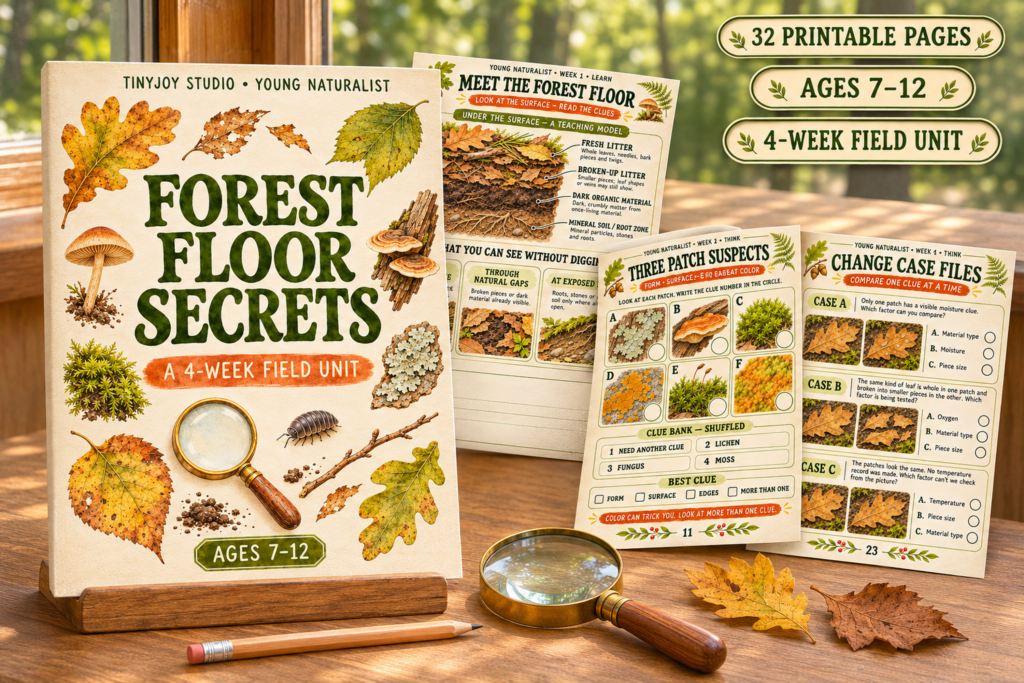
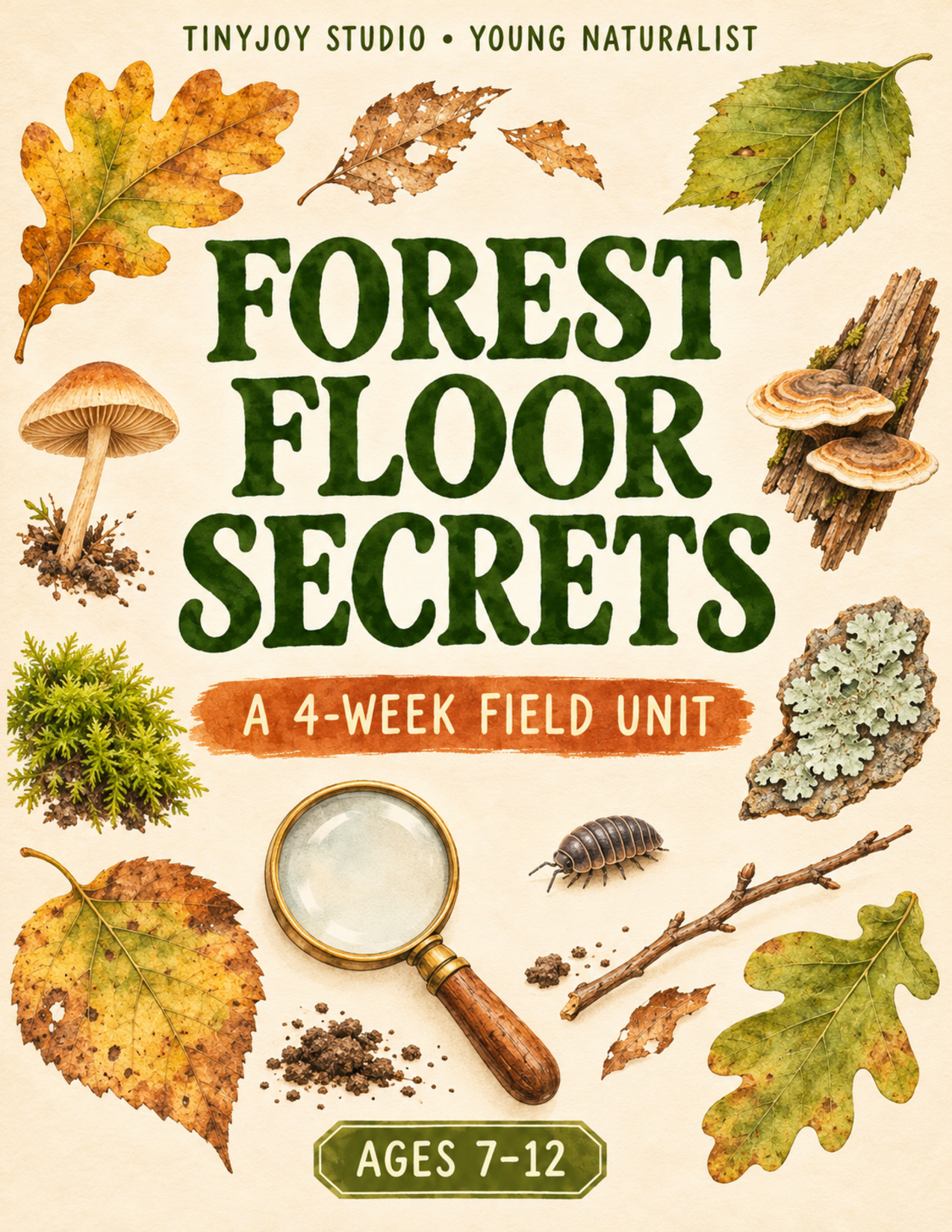
In Forest Floor Secrets: A 4-Week Field Unit (designed for ages 7–12 by TinyJoy Studio), students develop the patient, non-destructive habits of field ecologists. Forming a vital tier of our Young Naturalist series—building on the foundational outdoor mindfulness of our nature journal for kids while connecting directly to the canopy studies in our tree identification for kids unit and the invertebrate investigations in our insects field unit for kids—this 32-page curriculum turns ground-level exploration into a disciplined, month-long investigation.

A Repeatable 4-Week Pulse: Learn, Think, Go, Observe, Make, Check
Young scientists build confidence when complex ecosystems are broken into a steady weekly rhythm. Forest Floor Secrets organizes four sequential investigations, designed for three to four short sessions each week:
- Week 1: What Is Underfoot? (Layers): Learning the four-layer teaching model—fresh litter, broken-up litter, dark organic material, and the mineral soil/root zone—while practicing surface-only observation without digging.
- Week 2: Fungus, Moss or Lichen? (Patches): Inspecting form, edges, and attachment surfaces to separate fungi, true plants, and symbiotic lichen partnerships.
- Week 3: Who Helps Recycle? (Recycling Team): Distinguishing physical shredders (pill bugs, millipedes, earthworms) from chemical decomposers (fungi and bacteria) and nearby predators (centipedes).
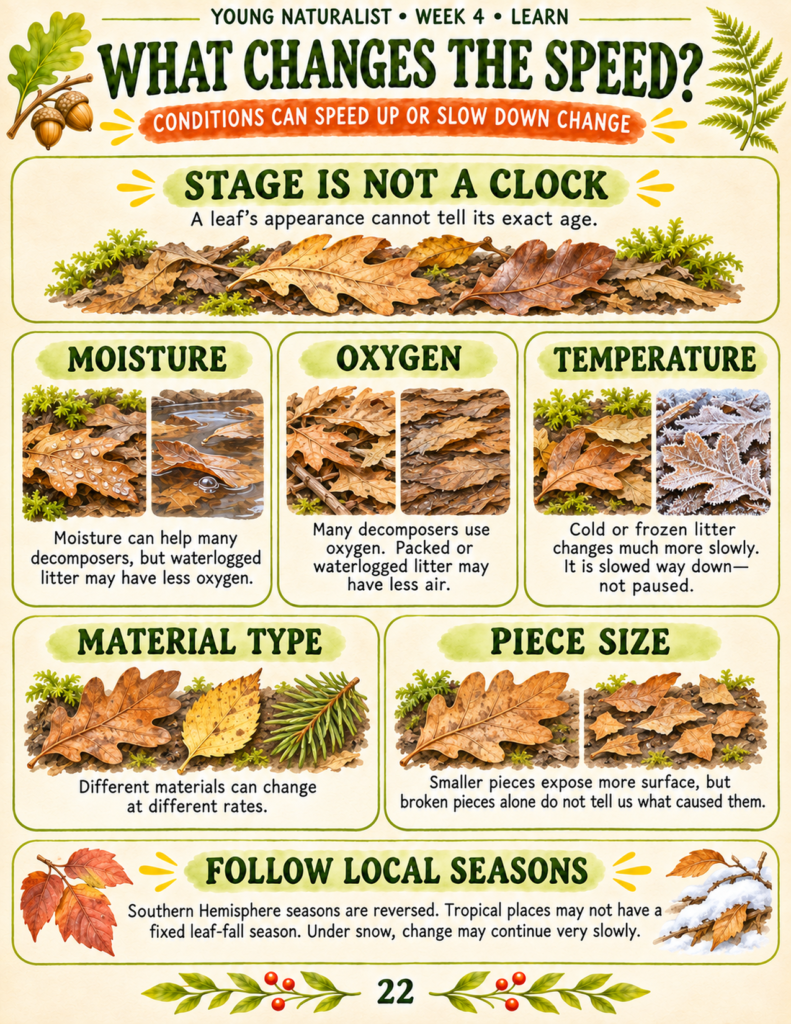
- Week 4: What Changes the Speed? (Change Over Time): Evaluating how moisture, oxygen, temperature, material type, and piece size accelerate or slow down transformation.
Each week moves through the exact same six-step inquiry loop: Learn a foundational concept, Think through a visual clue puzzle, Go on a timed 5- or 10-minute field scan, Observe and map evidence, Make a hands-on foldable or pathway model, and Check understanding with open-ended reflection prompts.
This disciplined practice of reading ground layers, moisture clues, and surface topography mirrors the spatial reasoning cultivated across our geography learning path for kids. Just as physical geography examines how climate, drainage, and parent rock shape regional landscapes, young naturalists discover that every square foot of woodland floor reflects the local balance of water, temperature, and organic matter.

Diagnostic Rigor: Separating Look-Alikes and Ecological Roles
One of the defining strengths of Forest Floor Secrets is its refusal to let children jump to conclusions from a single superficial clue:
- Form, Surface, and Edges Beat Color (Page 10–11): Children often assume that anything green on a log is moss. In Week 2, students compare a shelf fungus (not a plant, sometimes showing fine mycelium threads), moss (a small leafy plant with spore capsules on stalks), and lichen (a flat, crusty, or leafy partnership between a fungus and an alga or cyanobacterium). In the «Three Patch Suspects» exercise, children realize that color alone can trick an observer—an orange patch on rock might be crustose lichen, while an unlabeled grainy green-and-orange patch requires another clue before naming.
- Shredders, Decomposers, and Hunters Nearby (Page 16–17): In Week 3, students sort woodland organisms by their exact ecological jobs. Pill bugs, millipedes, and earthworms act as Shredders that bite and break dead leaves into smaller pieces; fungi and bacteria act as Decomposers that chemically transform dead material; meanwhile, fast-moving centipedes are classified accurately as Hunters Nearby that prey on small animals rather than eating dead leaves.
By asking children to record «Unlabeled white threads cross a damp patch — Need another clue» rather than guessing blindly, the curriculum builds genuine scientific humility. This commitment to testing evidence before making claims directly supports the empirical habits children practice in our earth and space science bundle for kids, where young astronomers learn to separate visual appearances from physical reality.


Stage Is Not a Clock: Matter Pathways and All-Weather Access
In Week 4, Forest Floor Secrets tackles one of the most common misconceptions in elementary ecology: the idea that a leaf’s appearance tells its exact age or that decayed matter simply vanishes.
Through the «Change Case Files» and the cut-and-glue «Build the Matter Pathway» activity (pages 23 and 26), students trace how environmental conditions—moisture, oxygen availability, temperature, leaf toughness, and fragment size—govern transformation speed. When cold or frozen winter weather arrives, decomposition is slowed way down rather than paused entirely. And when fallen litter finally breaks down, children map its three real destinations: returning to the air as carbon dioxide ($CO_2$), becoming part of living organisms, or remaining as dark soil organic matter and mineral nutrients.
Just as importantly, the workbook ensures that weather, snow cover, allergies, or urban living never block a child’s progress. Every observation log offers four flexible sources: Outdoors, through a Window, from a Photo, or via the illustrated Home Field Scenes on pages 28–29, which depict the exact same $12 \times 12$-inch ($30 \times 30$ cm) litter patch early on and later in the season across four study spots (A–D). Even returning to a patch and finding «No obvious change» is explicitly validated as meaningful scientific data.
Unlocking the Bottom-Center: The Discovery Mosaic Reward
Completing Forest Floor Secrets connects directly into the overarching collector experience of the Young Naturalist series:
- The Final Mission Synthesis (Page 30): Students bring all four weeks together in «The Changing Forest Floor,» documenting a real or illustrated patch using three independent clues and evaluating their certainty on the Clue Meter.
- The Discovery Piece (Page 31): Finishing the unit unlocks the official full-color Forest Floor Secrets discovery piece.
- Completing the Nine-Unit Poster (Page 32): When children cut out and paste this tile over the bottom-center space of their Collect & Complete / My Nature Discovery Mosaic poster, they reveal the rich forest-floor bedrock, ferns, mushrooms, and moss right beneath the central bug realm and adjacent to Rocks & Earth and Pond & Water Life.

Practical Ways to Use This Unit at Home and School
Designed for print-and-go simplicity—requiring only a pencil, crayons, ruler, child-safe scissors, glue, and an optional camera—Forest Floor Secrets fits smoothly into busy homeschool and classroom schedules:
- A 4-Week Nature Study Spine: Dedicate 15–20 minutes three times a week to one thematic module, revisiting the same $30 \times 30$ cm patch of leaves in a backyard, park, or planter box.
- Year-Round Indoor & Winter Science: Use the paired Fresh Litter Patch and The Same Patch Later teaching scenes (pages 28–29) alongside the cut-and-fold «Lift-the-Layer Window» and «Three-Way Field Foldable» during snowy months or rainy weeks.
- Multi-Age Sibling Exploration: Pair younger children (ages 7–9) focusing on surface mapping and sorting cards with older learners (ages 10–12) defending multi-clue hypotheses and tracing carbon and nutrient pathways.
If you are looking for a screen-free science unit that teaches children to look closely at the living ground beneath their feet, distinguish organisms by real structural clues, and understand how ecosystems recycle matter without disturbing nature, Forest Floor Secrets offers a thoughtful, hands-on field guide for ages 7–12.