Describe Before You Name: Teaching Elementary Geology Through Field Clues and Honest Evidence
Most elementary geology lessons start with a boxed set of polished stones and a worksheet asking children to memorize igneous, sedimentary, and metamorphic labels. Choosing an inquiry-driven rocks and soil workbook for kids is one of the clearest ways to shift young learners from guessing stone names to reading the actual physical clues preserved in rocks, soil layers, and sediment trails. When designed around real outdoor investigation, a rocks and soil workbook for kids teaches students to describe surface textures before naming anything, distinguish flat layers from wavy bands, test soil absorption, and recognize when «need another clue» is the most accurate scientific conclusion.
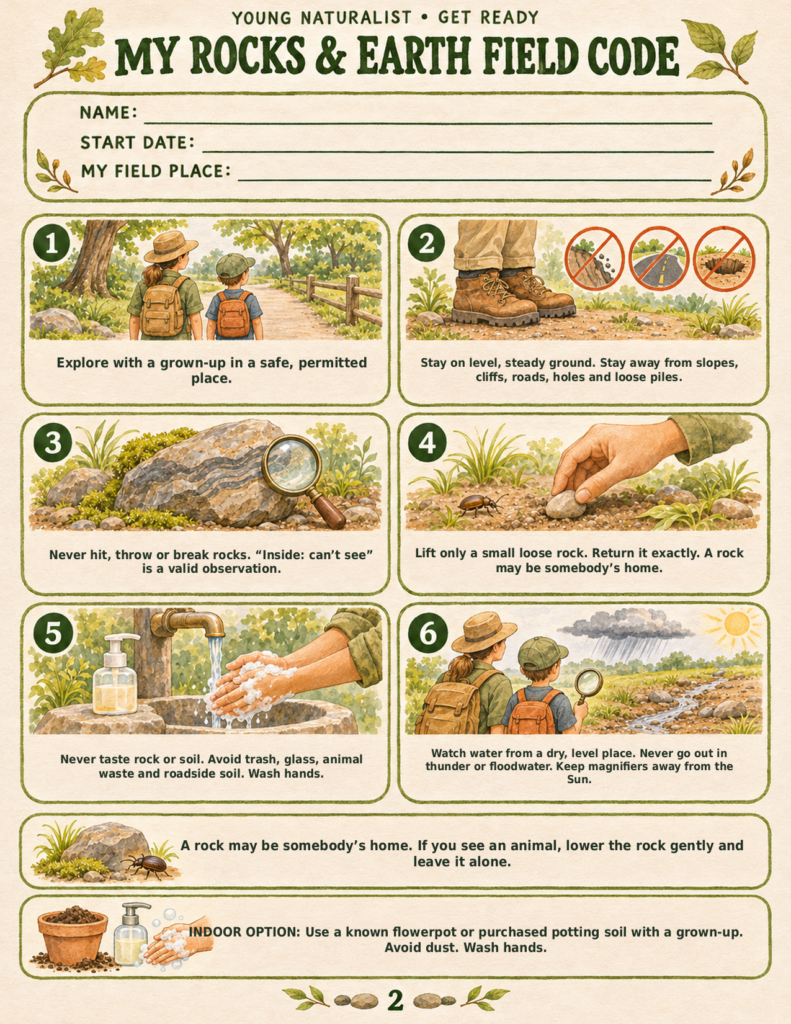
Standard classroom printables frequently encourage children to crack stones open with hammers or treat color as definitive proof of a rock’s identity. Both habits undermine real field science: color alone rarely reveals how a stone formed, and overturning or smashing rocks destroys microhabitats tucked beneath them. Without a structured method for evaluating visible evidence, children miss the quiet geological stories happening right under their boots—from plant roots widening cracks in granite to rainwater sorting pebbles along a garden path.

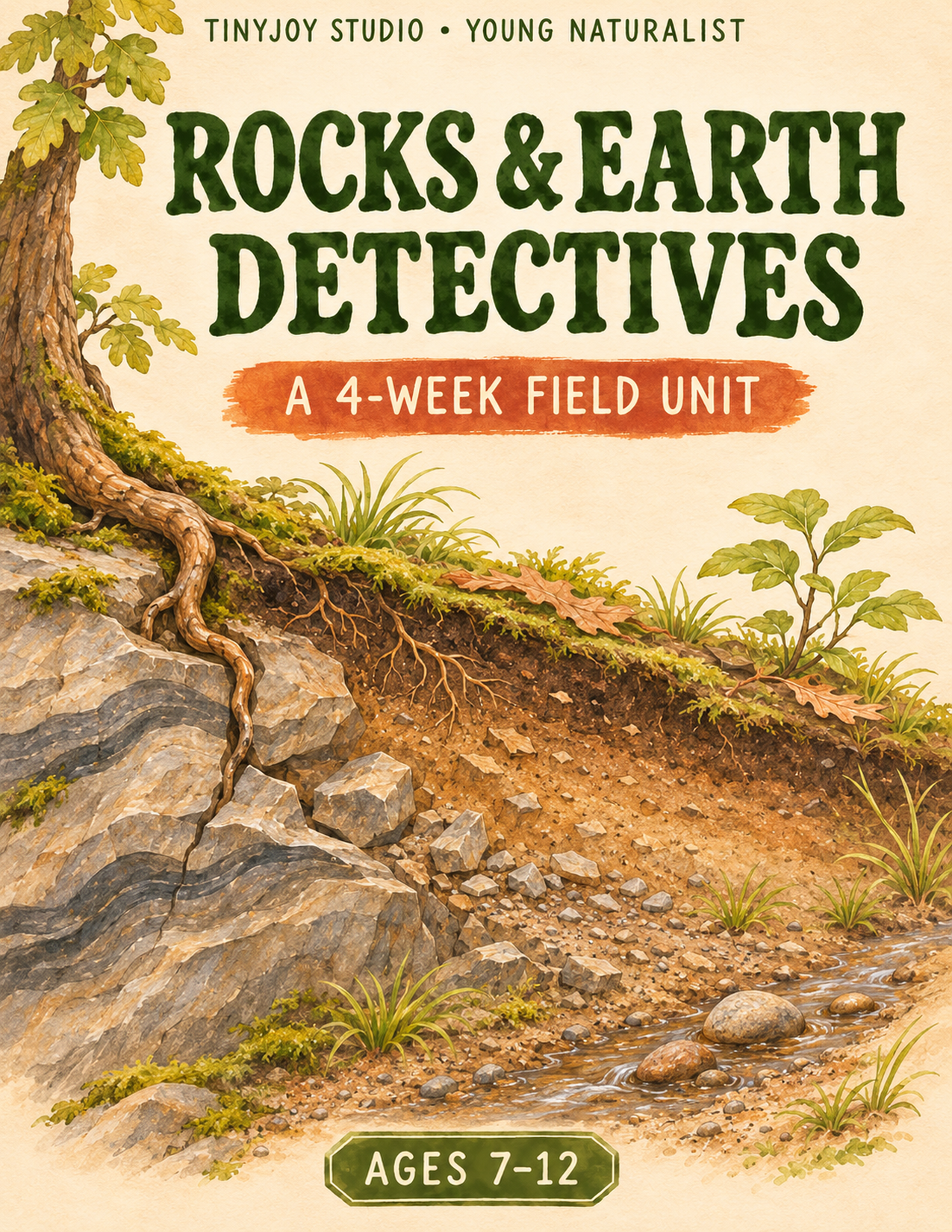
In Rocks & Earth Detectives: A 4-Week Field Unit (a 32-page printable guide for ages 7–12 in the TinyJoy Studio Young Naturalist series), children explore geology safely without hammers, acid bottles, or risky cliffside climbs. Following a consistent weekly rhythm—Learn → Think → Go → Observe → Make → Check—the unit works equally well on neighborhood walks, with indoor flowerpot soil, or alongside the illustrated two-page Home Field Scene (Pages 28–29) when outdoor access is limited.
Week 1: Describe Before You Name
Week 1 trains children to slow down and catalog eight observable rock clues—color, surface, grains, layers, bands, holes, sparkle, and edges—before jumping to conclusions. Students assemble a foldable Pocket Rock Clue Card to carry outdoors and learn to separate brick or concrete from genuine natural stone. Crucially, the unit normalizes scientific restraint: «Inside: can’t see» and «Case Open» are treated as rigorous answers whenever surface evidence is limited. That habit of inspecting stones without disturbing hidden creatures connects directly with exploring sub-rock and bark microhabitats in our insects field unit for kids.

Week 2: Three Earth Stories Without Guesswork
Instead of drowning students in heavy terminology, Week 2 frames rock formation around three accessible earth stories: Cooled Melt (solidified magma or lava), Packed Pieces (cemented grains and flat layers), and Heated & Squeezed (older rock altered by heat and pressure into aligned grains or wavy bands). In the Rock Clue Lineup and Earth Story Flapbook, children test rocks against two visible clues—discovering why a shiny obsidian-like stone or a uniform gray pebble with no visible grains requires choosing Need Another Clue rather than guessing.

Week 3: What Hides in Soil?
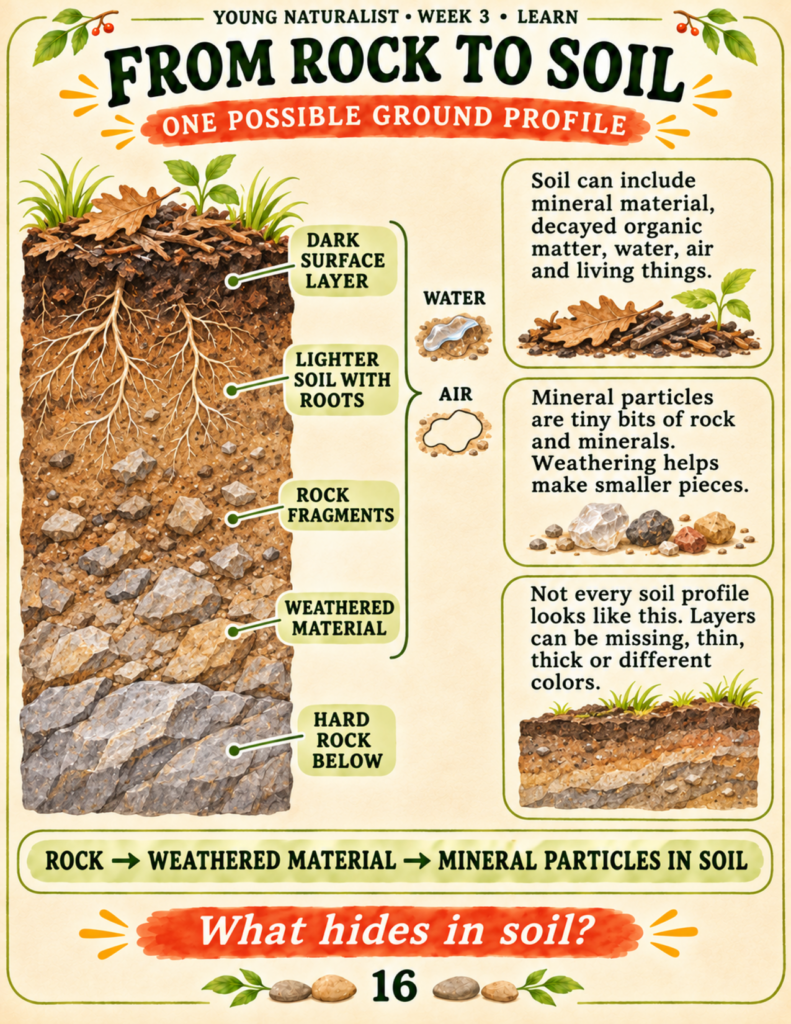
In Week 3, investigations move from solid stone to the living mixture beneath our feet. Studying a vertical ground profile—from the dark organic surface layer down through root zones, rock fragments, and weathered bedrock—students build a lift-the-flap Soil Window organizer. During the 10-Minute Soil Watch, learners place three drops of water onto safe garden or potting soil, watching whether water soaks in, beads up, or releases tiny air bubbles—an indirect clue proving trapped air pockets exist between mineral grains.
Understanding how weathered rock particles blend with decayed leaves and living roots pairs naturally with examining surface litter and decomposers in our forest floor science for kids unit, while observing how tree roots anchor into soil horizons complements our tree identification for kids guide.
Week 4: Break, Move, Rest—and the Discovery Mosaic
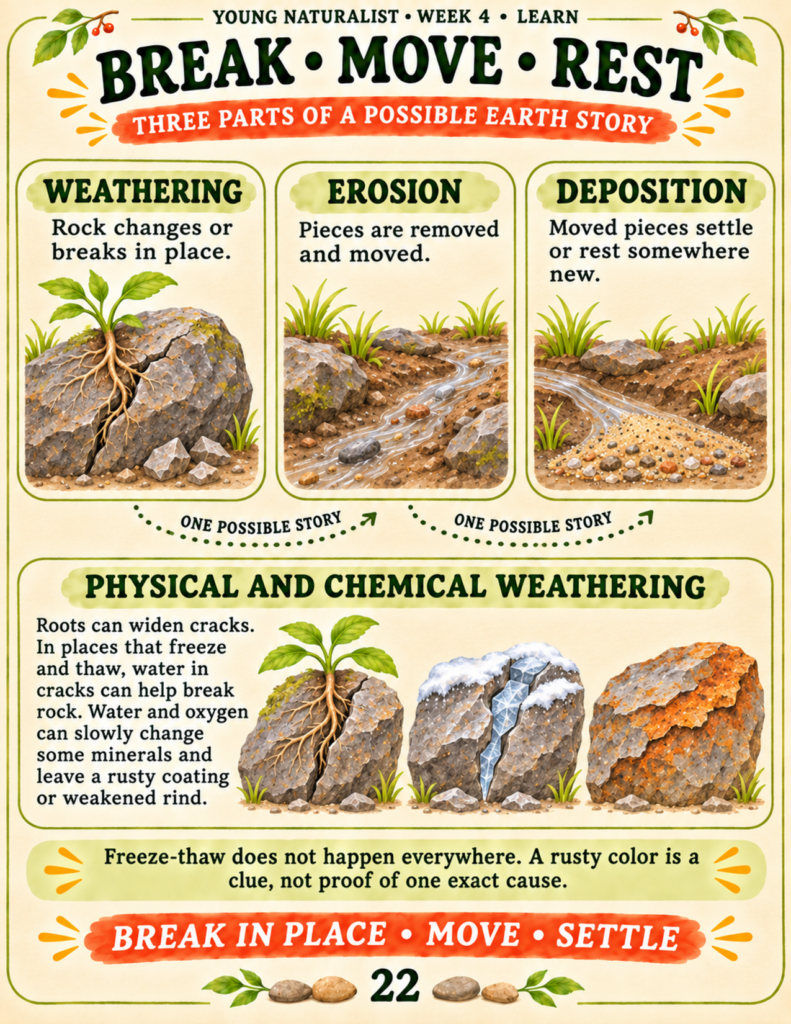
Week 4 ties geology to surface dynamics through a three-part sequence: Weathering (breaking in place via plant roots, freeze-thaw cracks, or chemical rusting), Erosion (moving along a path), and Deposition (settling at rest). Whether inspecting a wet rain-day runoff line, a dry downspout fan, or a tilted sand-tray model indoors, learners map sediment trails and audit seven field scenes—learning to spot an isolated pebble on a paved path as «Can’t Tell» when no source or travel trail is visible.
Tracing how rain runoff carries fine sand and gravel connects seamlessly with tracking precipitation and surface moisture in our weather workbook for kids (Sky & Weather Watchers) and reading mud impressions in our animal tracks and bird signs for kids unit.
Upon completing the final My Earth Story Report on Page 30, students cut out the Rocks & Earth Discovery Piece—a full-color illustrated tile featuring quartz crystals, layered stones, and soil roots—and glue it into the bottom-left slot of the 9-unit My Nature Discovery Mosaic poster.

Practical Ways to Use This 4-Week Field Unit
Designed for ages 7–12 (grades 2–6), Rocks & Earth Detectives requires zero specialized rock-testing kits—just a pencil, crayons, scissors, glue, a cup of water, and an optional magnifier. When weather or location prevents outdoor exploration, families can use indoor potting soil, known landscaping stone, or the two-page illustrated Mystery Ground Trail (Pages 28–29) to complete every observation log.
If you want a ready-to-print, screen-free earth science unit that replaces passive stone memorization with genuine field observation and evidence-based reasoning, Rocks & Earth Detectives gives young naturalists a structured, four-week path into reading the ground beneath them.