Build, Decide & Grow: A Hands-On Kids Business Curriculum for Applied Math, Systems Thinking & Microeconomics
Most elementary financial literacy printables stop at two predictable exercises: counting coins on a worksheet or running a pretend lemonade stand where every customer buys happily and profit is guaranteed. Designed to take learners ages 8 to 12 far beyond basic arithmetic, the build decide and grow kids business curriculum from Tiny Joy Studio treats young minds as capable decision-makers—putting them in charge of realistic operations where time, inventory, cash, and staff are always limited.
As a dedicated pillar of the Tiny Joy Studio Learning Library, Build, Decide & Grow is an expanding curriculum ecosystem built around applied math, systems thinking, and real-world problem-solving. Today, this branch is anchored by our flagship 10-book microeconomics series, Business Evolution, with future sister lines—CityWorks and Career Lab—already in development to expand how young learners explore civic systems and real-world professions.

Business Evolution: 10 Businesses, 10 Ways to Think
At the heart of Build, Decide & Grow is Business Evolution—a collection of 10 complete, stand-alone business decision adventures. Rather than dumping intimidating textbook vocabulary on children up front, every workbook follows an experience-first learning loop: learners step into a manager’s role, make concrete operational choices before knowing the final outcome, analyze the numerical results, and only then name the economic principle they just experienced.
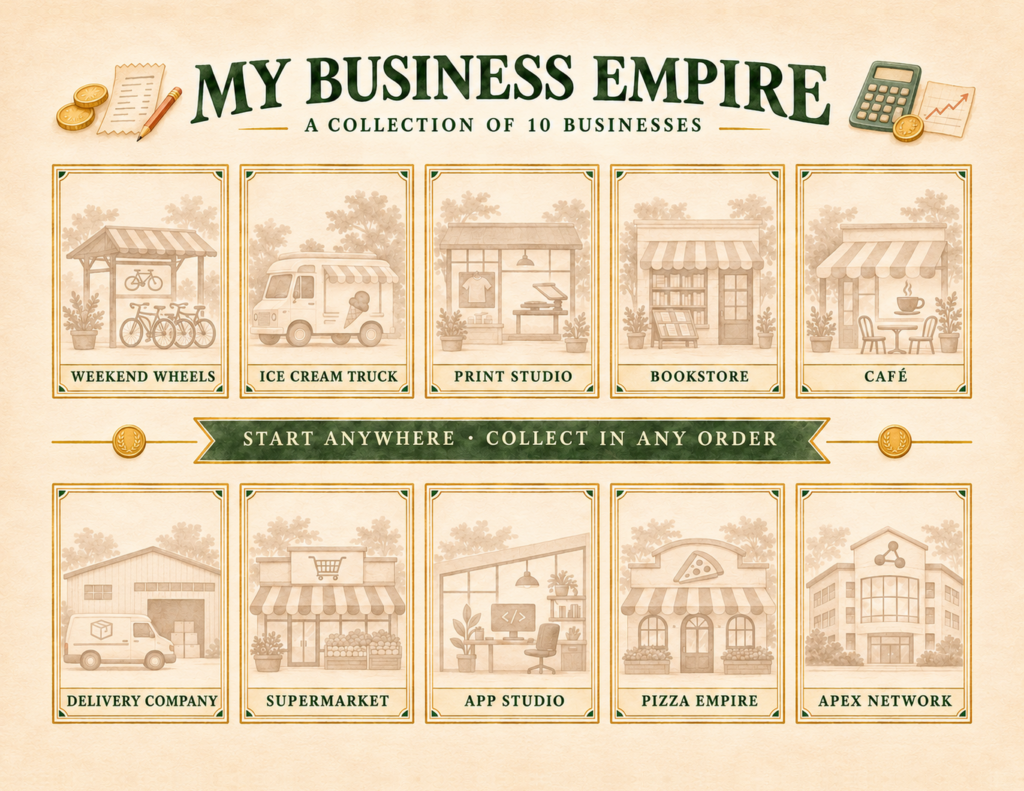
Because every volume is an independent mission with its own business model and rules, families can start anywhere and collect in any order:
1. Weekend Wheels — Opportunity Cost & Capacity
In our flagship business workbook for kids, learners manage a neighborhood bike rental kiosk with 4 bikes and 4 two-hour time blocks. When advance bookings arrive early, accepting a full-day rider means locking in guaranteed revenue—but potentially blocking higher-paying last-minute walk-ins. Children calculate opportunity cost directly from their own schedule and learn why smart decisions must be judged by the clues available before the outcome is known.

2. Ice Cream Truck — Forecasting & Inventory
Running a mobile ice cream truck teaches a classic retail balancing act: order too few cones and you lose eager customers on a sunny afternoon; order too many and melting stock eats away your profit. Learners read weather clues, neighborhood foot-traffic patterns, and past sales records to forecast demand and prepare the right inventory before opening the service window.
3. Print Studio — Quality Control & Rework
Fast production looks profitable on paper—until rushed orders come back with misprints and smudges. Inside Print Studio, students balance turnaround speed against careful inspection, discovering the hidden cost of rework: fixing a mistake does not just waste paper and ink, it steals production capacity from the next paying customer.
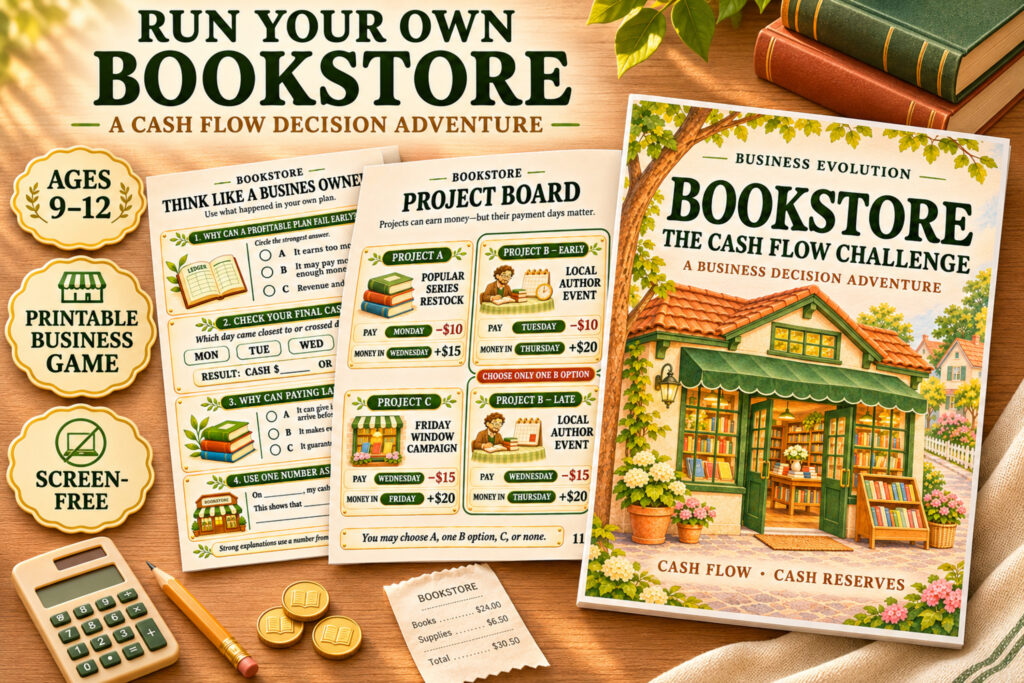
4. Bookstore — Cash Flow & Cash Reserves
Even a profitable shop can fail on Tuesday if rent comes due before customer payments arrive. Featured in our cash flow workbook for kids, Bookstore challenges learners to track daily opening and closing balances across a five-day week, resist spending every available dollar on tempting projects too early, and protect an $8 cash reserve floor against mid-week shortages.
5. Café — Team Roles & Workflow
When the morning rush hits a busy neighborhood café, one person cannot take orders, brew drinks, plate pastries, and clear tables all at once. Learners design station assignments and clear handoffs, discovering how well-defined team roles and smooth workflow prevent counter bottlenecks and keep customers happy.
6. Delivery Company — Logistics & Deadlines
Moving packages across town is never just about driving fast. In Delivery Company, students map multi-stop routes, weigh van load limits, and sequence drop-offs so every parcel arrives before its promised deadline without wasting fuel or backtracking across neighborhoods.
7. Supermarket — Pricing & Demand
Most kids assume charging the highest price tag automatically earns the most money. In our pricing and demand workbook for kids, learners run controlled “What-If Price Tests” across 12 shoppers with distinct “Most I’d Pay” limits—discovering how price changes shift buyer volume, how variable item costs affect margin, and why changing a store’s goal changes the winning price.

8. App Studio — Market Research & Idea Validation
Building an app nobody wants is an expensive mistake. App Studio puts young founders in the research lab before coding begins—gathering user feedback, testing competing features against real evidence, and validating whether an idea solves an actual problem before investing time and budget into building it.
9. Pizza Empire — Scaling & Standardization
What works smoothly in one neighborhood pizzeria often breaks down when you open three branches across town. Pizza Empire introduces scaling and standardization, challenging learners to turn recipes, prep checklists, and quality standards into repeatable systems that grow a successful business without losing control.
10. Apex Network — Supply Chains & Bottlenecks
In the series capstone, learners zoom out from a single storefront to manage an interconnected network of suppliers, workshops, warehouses, and retail hubs. When one link in the supply chain slows down or stalls, students diagnose the bottleneck and reroute resources to keep the entire network running.
Collectible Progression: Building My Business Empire
To make long-term learning feel like an authentic tabletop campaign rather than a stack of disconnected worksheets, every Business Evolution workbook includes a hands-on collector reward:
- Earn One Collectible Business Card per Book: Completing the final Owner Review in any volume unlocks a cut-out illustrated business card featuring that enterprise’s storefront and core economic badge.
- Build Your 10-Business Portfolio: Learners assemble their earned cards onto the master My Business Empire: A Collection of 10 Businesses portfolio sheet—visually tracking their journey from a single weekend kiosk to a multi-branch network.
- Zero Required Sequence: Whether a child starts with Supermarket because they love grocery math, App Studio because they dream of designing games, or Weekend Wheels for a family game night, every completed challenge adds a permanent piece to their personal empire.
Quick Reference: All 10 Business Evolution Adventures
| Business Title | Core Microeconomics & Operations Focus | Key Decision Challenge |
| 1. Weekend Wheels | Opportunity Cost & Capacity | Balance guaranteed early bike bookings against uncertain walk-in demand |
| 2. Ice Cream Truck | Forecasting & Inventory | Use weather and neighborhood clues to stock the right amount before rush hour |
| 3. Print Studio | Quality Control & Rework | Weigh production speed against inspection quality and the cost of fixing errors |
| 4. Bookstore | Cash Flow & Cash Reserves | Keep daily cash above an $8 reserve floor when bills arrive before customer payments |
| 5. Café | Team Roles & Workflow | Assign staff stations so orders move smoothly without counter bottlenecks |
| 6. Delivery Company | Logistics & Deadlines | Plan efficient multi-stop delivery routes while keeping every time promise |
| 7. Supermarket | Pricing & Demand | Run controlled price tests to balance profit per item against shopper volume |
| 8. App Studio | Market Research & Idea Validation | Test customer evidence before investing resources into a new digital product |
| 9. Pizza Empire | Scaling & Standardization | Expand a successful restaurant across locations without losing product quality |
| 10. Apex Network | Supply Chains & Bottlenecks | Keep connected businesses operating when one upstream link slows down or fails |
The Growing Build, Decide & Grow Roadmap: What Comes Next
We designed Build, Decide & Grow as a living pillar hub that will continue expanding across real-world civic and career domains. Alongside the 10-book Business Evolution series, two companion branches are currently in development:
- CityWorks (Planned Series): Moving from individual businesses to shared public infrastructure, CityWorks will invite young planners to design water grids, transit corridors, energy networks, and civic budgets—exploring how communities solve shared engineering and resource challenges.
- Career Lab (Planned Series): Bridging classroom curiosity with real-world professions, Career Lab will place learners inside authentic workplace problem-solving scenarios—testing how architects, engineers, researchers, editors, and coordinators make daily decisions.
Connecting Economics to History & Broader Homeschool Studies
Real economic choices never happen in isolation—they are shaped by geography, transport routes, and centuries of human trade. Families using Business Evolution for applied math and critical thinking often pair these challenges with our Explore the Past history curriculum for kids to see how ancient merchants, river ports, and historic trade networks wrestled with the exact same questions of supply, pricing, and risk. To browse all seven curriculum branches across science, geography, nature study, history, and economics, visit the complete Tiny Joy Studio Learning Library.
Whether you are building a semester-long homeschool economics block or looking for screen-free weekend strategy challenges that give elementary math genuine purpose, the build decide and grow kids business curriculum turns everyday numbers into thoughtful, confident decision-making.