Why a Profitable Business Can Still Run Out of Cash: Teaching Cash Flow and Reserves to Kids
When children learn basic business math, they are usually taught a single equation: subtract total costs from total revenue, and if the number at the end is positive, the business succeeds. Introducing a thoughtful cash flow workbook for kids reveals a critical real-world catch that final totals hide. Even when a business earns a healthy profit by Friday, it can still fail on Tuesday if bills come due before customer payments arrive. A well-designed cash flow workbook for kids turns that timing puzzle into a concrete, day-by-day decision adventure—putting young learners in charge of a neighborhood bookstore where every bill must be paid on time and a protected cash reserve must remain untouched.
In real entrepreneurship, when money moves matters just as much as how much moves. Teaching students to track opening and closing balances across a week, resist spending every available dollar on a tempting opportunity, and back up their reasoning with ledger numbers builds financial intuition far deeper than standard arithmetic drills.
Learning Through Contrast: Same Profit, Different Cash Path
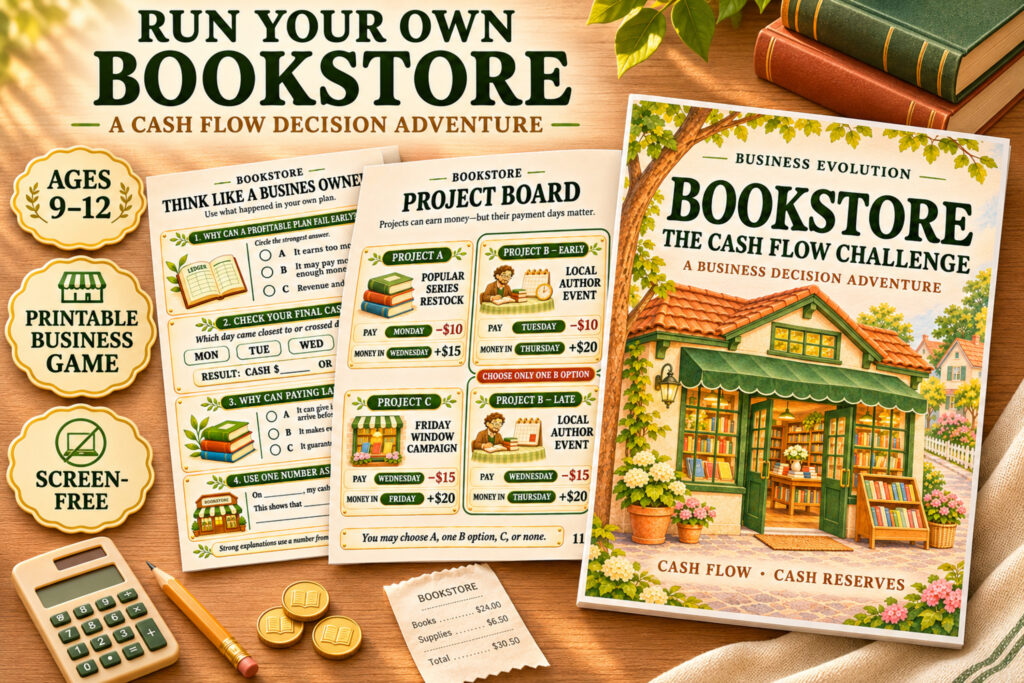
Bookstore: The Cash Flow Challenge — A Business Decision Adventure is a 29-page standalone release in TinyJoy Studio’s Business Evolution series for ages 9 to 12, paired with a comprehensive 9-page Grown-Up Guide and Answer Key. Rather than opening with accounting jargon, the workbook lets students experience a cash crunch firsthand before naming the concept:
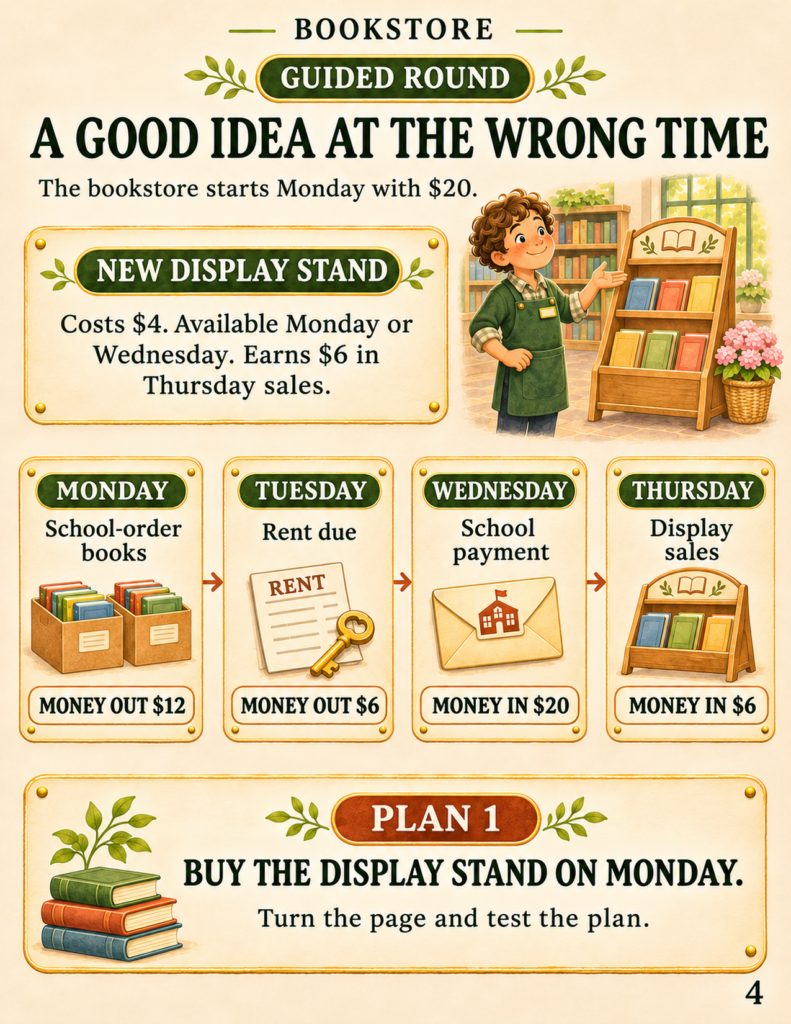
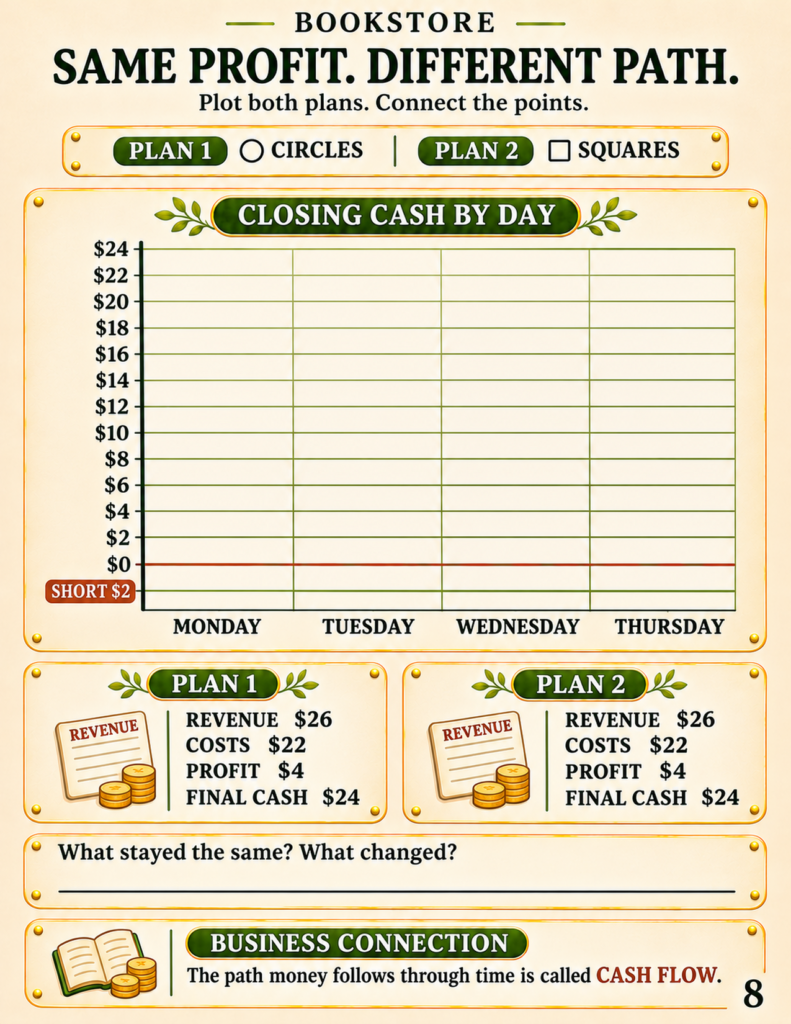
- Guided Round — A Good Idea at the Wrong Time (Pages 3–8): Starting Monday with $20, the bookstore must pay $12 upfront for a local school’s book order on Monday and $6 for rent on Tuesday, while the school’s $20 payment does not arrive until Wednesday. Students test Plan 1 (buying a $4 display stand on Monday) and discover that although the stand earns $6 on Thursday, Tuesday’s cash drops to $0—leaving the shop SHORT BY $2 on rent. Testing Plan 2 (waiting until Wednesday to buy the stand) produces the exact same $26 revenue, $22 costs, and $4 profit, yet keeps every bill paid on time. Plotting both paths on a daily line graph makes the definition of cash flow immediately visible.
- The Five-Day Mission & Protected Cash Reserves (Pages 9–16): In the main challenge, learners start Monday with $42 and must reach Friday with at least $70 ($62 for Saturday’s new book shipment plus $8 in Protected Money) while keeping closing cash at $8 or more every single day. Because the base week alone ends at $60 on Friday, students must select from optional projects—Project A (Popular Series Restock), Project B Early or Project B Late (Local Author Event), and Project C (Friday Window Campaign)—making a written prediction before running a day-by-day Trial Ledger.
- Rethinking, Refining, and Defending With Evidence (Pages 17–28): After graphing their Trial Path and checking whether they dipped into Protected Money, learners revise one strategic choice for their Final Plan. A dedicated STOP page on Page 23 prevents peeking ahead before grown-ups review their work, after which students examine three verified winning paths (B Early, A + B Late, and A + C) that all earn $28 profit while traveling very different daily risk profiles.

Why Timing and Cash Reserves Build Real Financial Judgment
What separates Bookstore from typical kids’ money worksheets is how cleanly it exposes common financial traps:
- Why Paying More Later Can Be Safer: When combining Project A with the Local Author Event, A + B Early earns $33 profit and $75 on Friday—yet fails because Tuesday falls SHORT BY $2. Choosing A + B Late costs $5 more on Wednesday, lowering Friday profit to $28, but waiting allows Project A’s Wednesday revenue to arrive in time to cover the expense safely.
- Respecting Cash Reserves Without Counting Them as a Cost: The workbook explicitly distinguishes Cash Reserves ($8 kept protected for change, returns, and surprises) from business expenses—teaching students that protected money still belongs to the shop even though it cannot be spent on daily projects.
- Evidence-Based Explanations: Rather than accepting vague answers like “Plan 2 is better,” the Think Like a Business Owner review (Page 28) and the Grown-Up Rubric require children to cite a specific day and dollar figure from their ledger to defend their conclusion.

Connecting Cash Flow Across the Tiny Joy Studio Ecosystem
Bookstore builds directly on the analytical foundations of our wider Business Evolution line. While our flagship business workbook for kids (Weekend Wheels) trains learners to weigh opportunity cost and fixed daily capacity, and our pricing and demand workbook for kids (Supermarket) explores how retail prices shift shopper demand and variable unit costs, Bookstore adds the third essential pillar of real-world business math: cash timing and liquidity reserves. Completing the challenge unlocks the collectible Bookstore card on Page 29 to add to the 10-business My Business Empire portfolio.
Families looking to pair practical economics with broader humanities and science units can browse all seven curriculum branches inside the Tiny Joy Studio Learning Library, or trace how merchants, trade routes, and banking systems evolved across civilizations inside our Explore the Past history curriculum for kids.

Practical Ways to Use Bookstore: The Cash Flow Challenge at Home and School
Designed for a 45- to 75-minute session (or two shorter blocks) using only a pencil, an eraser, and standard US Letter paper, the workbook adapts smoothly to multiple settings:
- A Two-Session Homeschool Applied Math Unit: Complete the Guided Round and Trial Plan in Session 1, pause at the Page 23 STOP checkpoint, and run the Final Plan, comparison graph, and Business Toolkit reflection in Session 2.
- Parent-Child Coaching Without Giving Away Answers: The 9-page Grown-Up Guide provides a complete strategy key covering all 12 project combinations alongside diagnostic prompts (“Which day became unsafe first?”) so adults can check arithmetic while letting children own their strategic choices.
- Upper-Elementary Classroom Economics Stations: Have pairs test different project combinations on the Trial Ledger and compare how two plans with identical $28 profits (B Early vs. A + C) experience completely different mid-week risk cushions.
If you want a ready-to-print resource that moves upper-elementary math beyond static budgets into real cash-flow timing, ledger tracking, and reserve management, Bookstore: The Cash Flow Challenge gives young thinkers a clear, engaging introduction to how healthy businesses stay solvent every day of the week.