Screen-Free Homeschool Activities: A Complete Learning Guide for Curious Kids (Ages 6–12)
Stepping away from tablets, video lessons, and gamified apps is one of the highest priorities for modern homeschool families—yet replacing digital screens with stacks of generic worksheets or random craft busywork rarely holds a child’s interest for long. Truly engaging screen-free homeschool activities do not ask children to passively copy definitions or color cartoon icons; they put physical evidence, maps, field notes, and real-world trade-offs directly into a learner’s hands. When designed around genuine questions and tactile problem-solving, screen-free homeschool activities build deeper focus, stronger spatial memory, and independent reasoning across ages 6 to 12.
✦ FREE HOMESCHOOL RESOURCE ✦
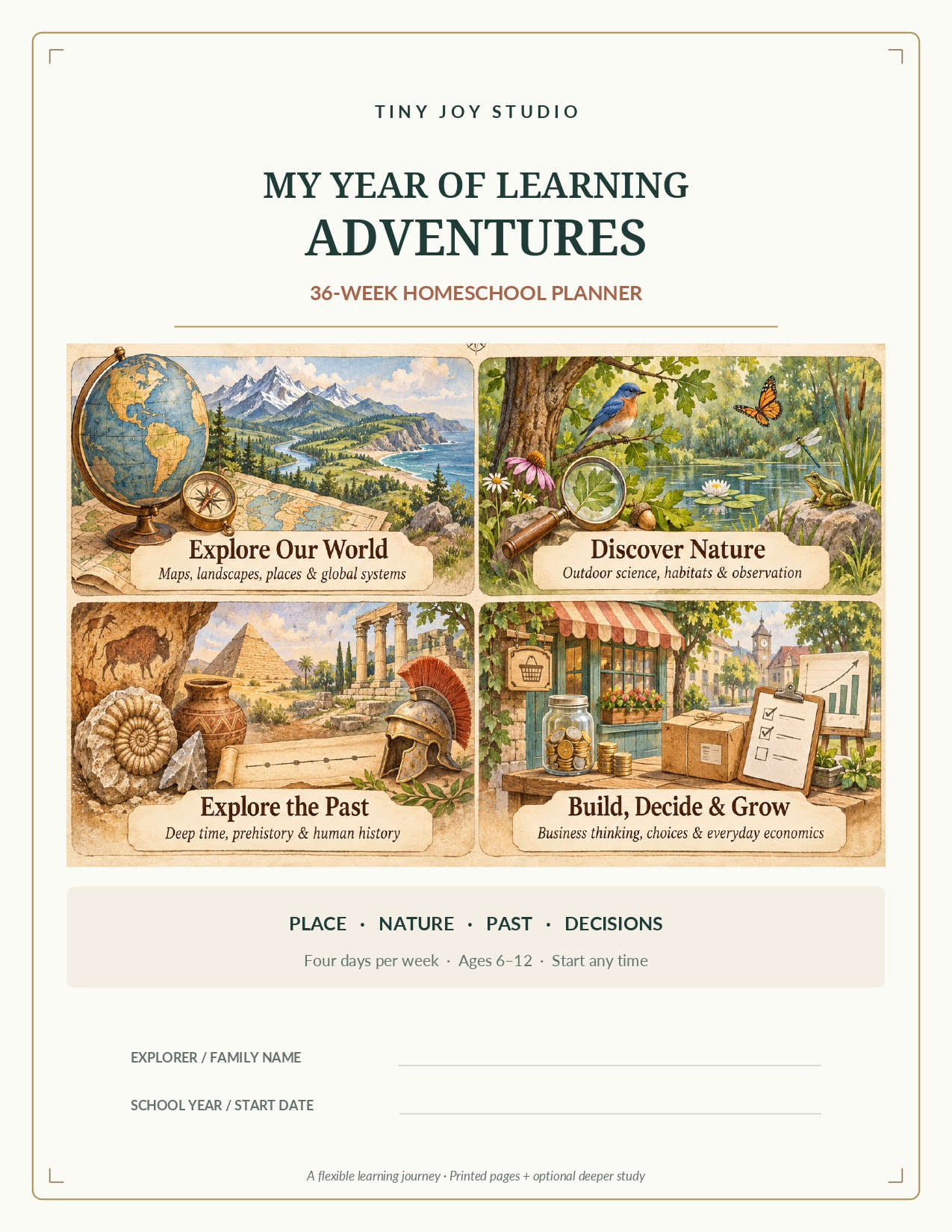
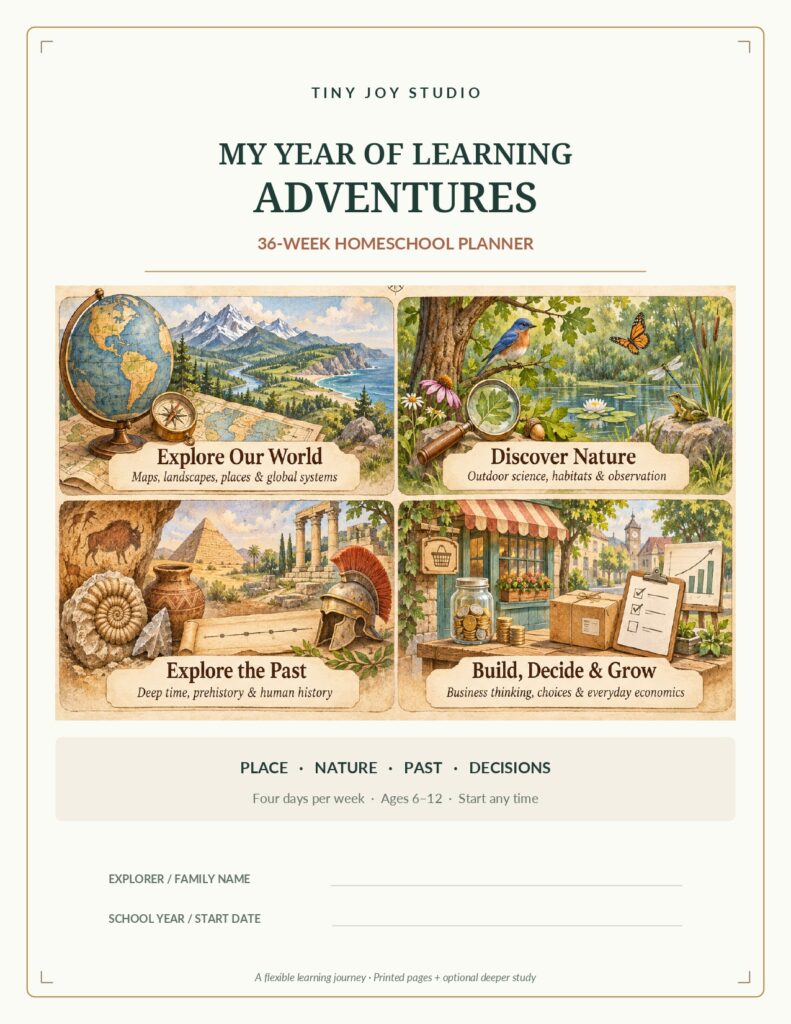
Your 36-Week Homeschool Learning Planner
A free 58-page printable planner with 36 themed weeks, four connected learning paths, age-adapted activities, and weekly reflections for curious learners ages 6–12.
Free PDF · US Letter · No Purchase Required
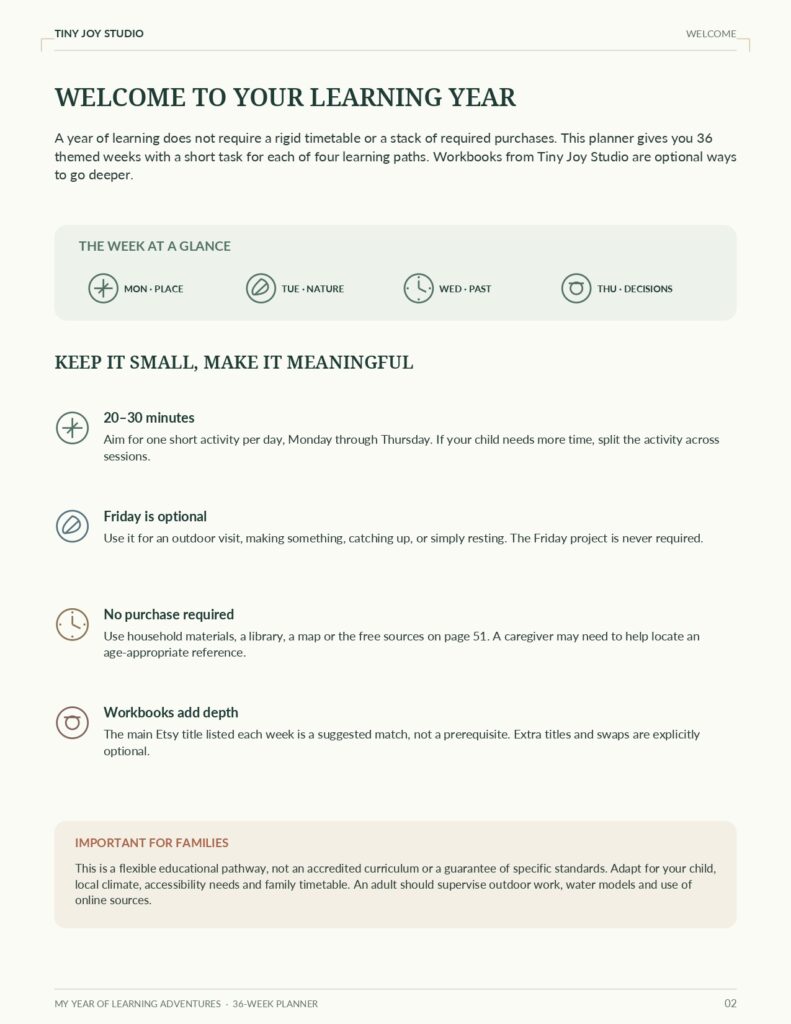
Whether you are transitioning away from screen-heavy online programs, teaching two different grade levels at the same kitchen table, or looking for a calm 20- to 30-minute daily structure that actually sticks, this guide walks through how to build a complete, tactile learning routine at home.
Why Most “No-Screen” Lists Burn Out by Week Three
Many printable roundups promise months of screen-free learning but hand parents 50 disconnected one-off ideas with no progression. Children quickly sense when an activity is just filling time, and parents end up exhausted from hunting down supplies every Sunday night.
Sustainable offline learning works best when it relies on three simple shifts:
- Methods Over Memorization: Instead of drilling isolated state capitals or battle dates, give children repeatable thinking tools—reading map scale, separating direct observation from inference, checking source dates, and weighing limited budgets.
- Everyday Household Materials: The most effective offline labs require nothing more than pencil, paper, a ruler, six play coins or buttons, a tray with foil, and an outdoor park or window view.
- One Shared Topic, Two Challenge Tiers: Instead of running separate curricula for younger and older siblings, keep the whole family exploring the same weekly question while adjusting the output for Ages 6–8 (drawing, sorting, labeling, and oral explanation) versus Ages 9–12 (multi-variable comparison tables, model testing, and evidence-backed claims).
Four High-Impact Categories of Screen-Free Learning
To keep lessons balanced without overwhelming your week, anchor your offline sessions around four complementary domains—mirroring the structure of our Tiny Joy Studio Learning Library and our 36-week year of learning adventures at home:
1. Tactile Cartography & Physical Terrain Models (Place)
Children understand geography far better when they sketch routes by hand rather than tapping a digital map. Start by having learners draw a route from home to a familiar landmark with a three-symbol key, pace out a short distance outdoors to test scale, or fold scrap paper into a relief mountain pass to test why a longer, flatter road can beat a steep shortcut. For structured skill progression, pair these tabletop exercises with our Explore Our World geography curriculum for kids and the Explorer Skills Workbook Bundle.
2. Real-World Field Logs & Tabletop Science Models (Nature)
Offline science thrives on quiet, repeated observation. Children can map a $30 \times 30$ cm patch of fallen leaves without digging, compare shadow angles at two times of day, or use a lamp and ball to model axial tilt and seasons. When bad weather keeps you indoors, our Discover Nature science curriculum for kids—including My First Nature Journal (nature journal for kids) and nine 4-week Young Naturalist field units—pairs outdoor checklists with detailed illustrated Home Field Scenes so observation never stalls.
3. Primary-Source Clue Audits & Historical Timelines (Past)
Rather than reading dry textbook summaries, turn history and prehistory into detective work. Give learners a three-column sheet labeled OBSERVED / INFERRED / UNKNOWN to examine a fossil photograph, an ancient inscription, or a Roman aqueduct diagram—and even test water flow down a tilted foil channel on a kitchen tray. Families can deepen these investigations across our Explore the Past history curriculum for kids, combining Prehistoric Earth workbooks for kids, the 18-part interactive history for kids curriculum (Time Traveler), and Focused History unit studies for kids.
4. Tabletop Ledger & Trade-Off Simulations (Decisions)
Practical math comes alive when children manipulate physical counters and seven-day calendars. Place six play coins on the table and challenge your child to divide them between TODAY, LATER, and BILLS when a customer payment arrives late, or test how changing a market price shifts leftover stock. Our Build, Decide & Grow kids business curriculum expands this tactile logic across ten standalone business simulations—including our business workbook for kids (Weekend Wheels), cash flow workbook for kids (Bookstore), and pricing and demand workbook for kids (Supermarket).
Free Download: My Year of Learning Adventures — 36-Week Homeschool Planner (58-Page Printable PDF)
To help you put this screen-free rhythm into practice right away—with zero required purchases—we created a complete 58-page printable homeschool planner for ages 6 to 12:
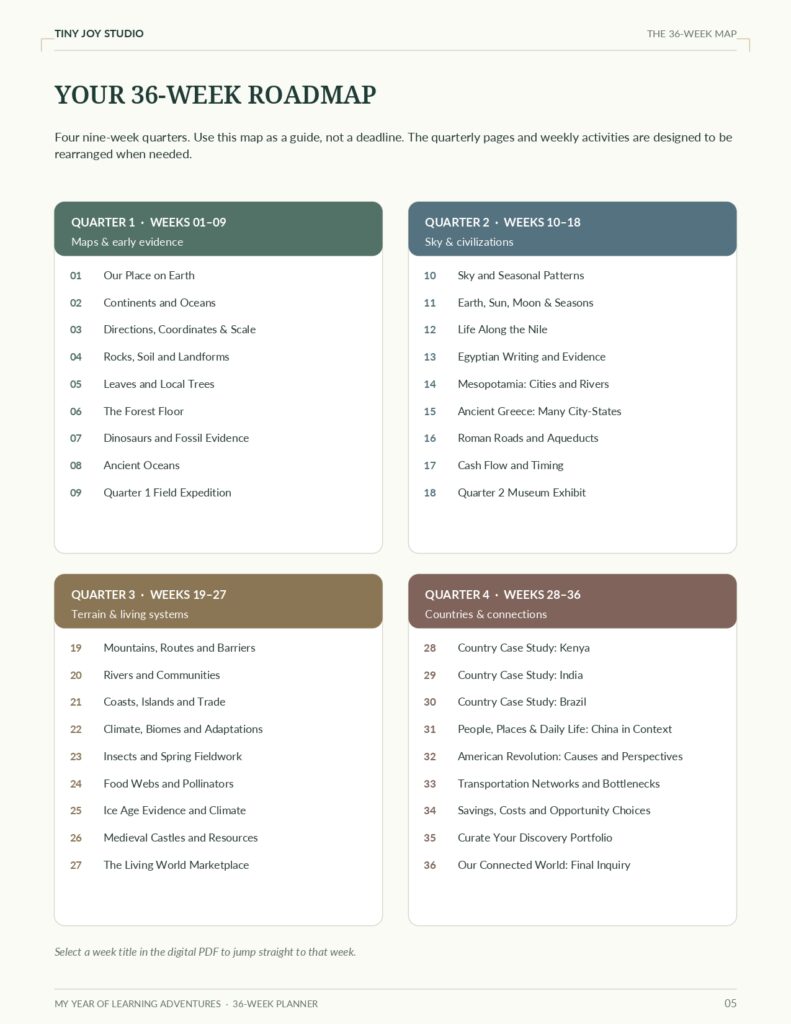
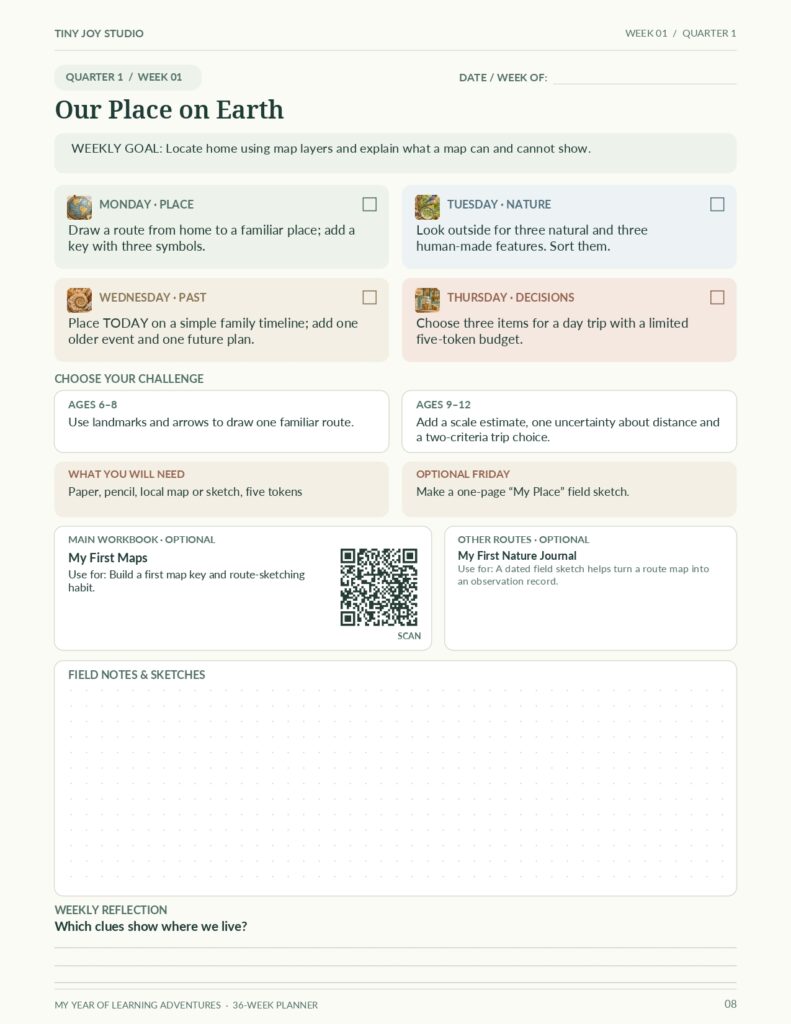
- 36 Complete Weekly Activity Sheets: Organized into four 9-week quarters (World Maps & Early Evidence, Ancient Civilizations & Space Mechanics, Global Biomes & Terrain, and Individual Countries & Scaling Systems), each featuring daily prompts for Monday–Thursday plus an optional Friday project.
- Built-In Multi-Age Differentiation: Every single weekly page includes tailored Ages 6–8 and Ages 9–12 challenge tracks so siblings can learn side by side.
- Zero-Cost Household & Library Ready: Every activity can be completed with basic home supplies, a local library, and our curated directory of free public museum and science archives (OpenStreetMap, NASA Space Place, Smithsonian, NOAA, USGS, and the Library of Congress) on Page 51.
- Optional Workbook Pairings & Country Swaps: Each week lists optional matching Tiny Joy Studio workbooks (with clickable links and QR codes) plus complete country and history swaps on Page 52 if your learner wants to substitute Japan, Mexico, South Africa, or Ancient China.
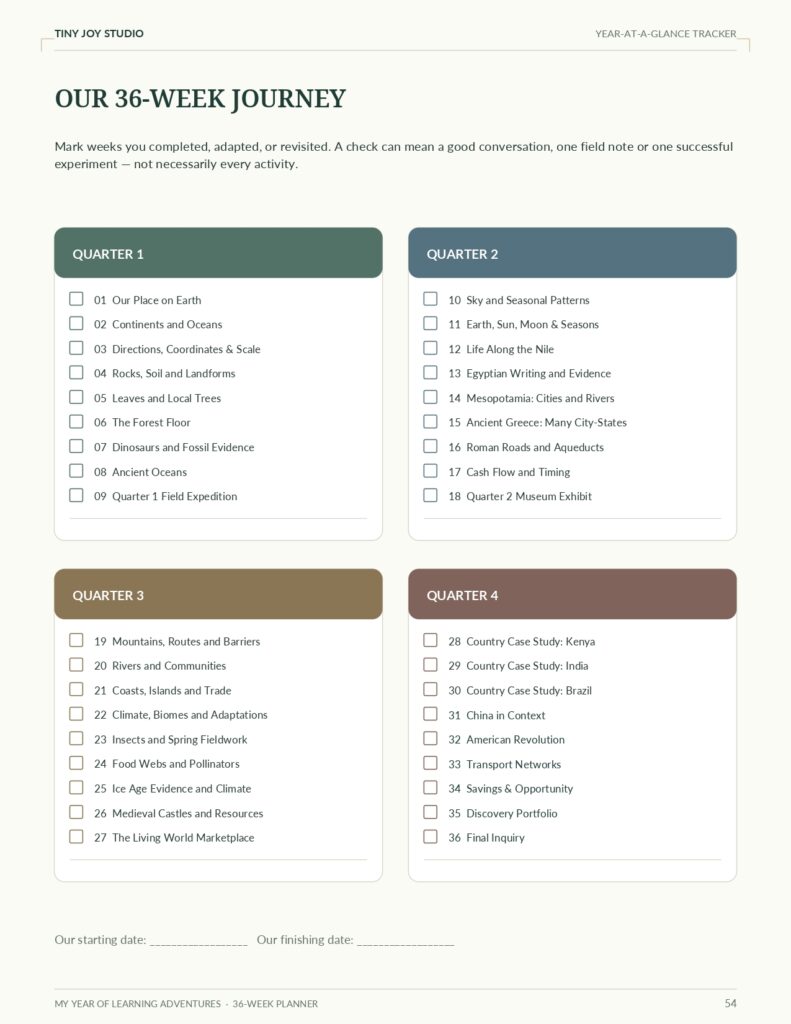
- Quarterly Check-Ins & Year-End Portfolio Templates: Includes a Year-at-a-Glance Tracker, Progress Through the Year rubric, and four-panel Learning Portfolio sheets to document real growth without grades or busywork.
✦ FREE HOMESCHOOL RESOURCE ✦
Your 36-Week Homeschool Learning Planner
A free 58-page printable planner with 36 themed weeks, four connected learning paths, age-adapted activities, and weekly reflections for curious learners ages 6–12.
Free PDF · US Letter · No Purchase Required
How to Make Screen-Free Learning Stick All Year
Even the best printable guide works only when it fits real family life. Keep these three habits in mind as you start:
- Treat Missed Weeks as Pauses, Not Failures: If travel, illness, or sunny weather interrupts your schedule, never try to “double up” and catch up on every missed box—simply pick up on the next week or jump to a seasonal topic that fits right now.
- Save One Artifact Per Week: Instead of keeping giant binders of completed worksheets, save just one meaningful piece of evidence each week—a hand-drawn route map, a dated leaf sketch, a two-column fossil chart, or a revised budget table—to build a curated year-end portfolio.
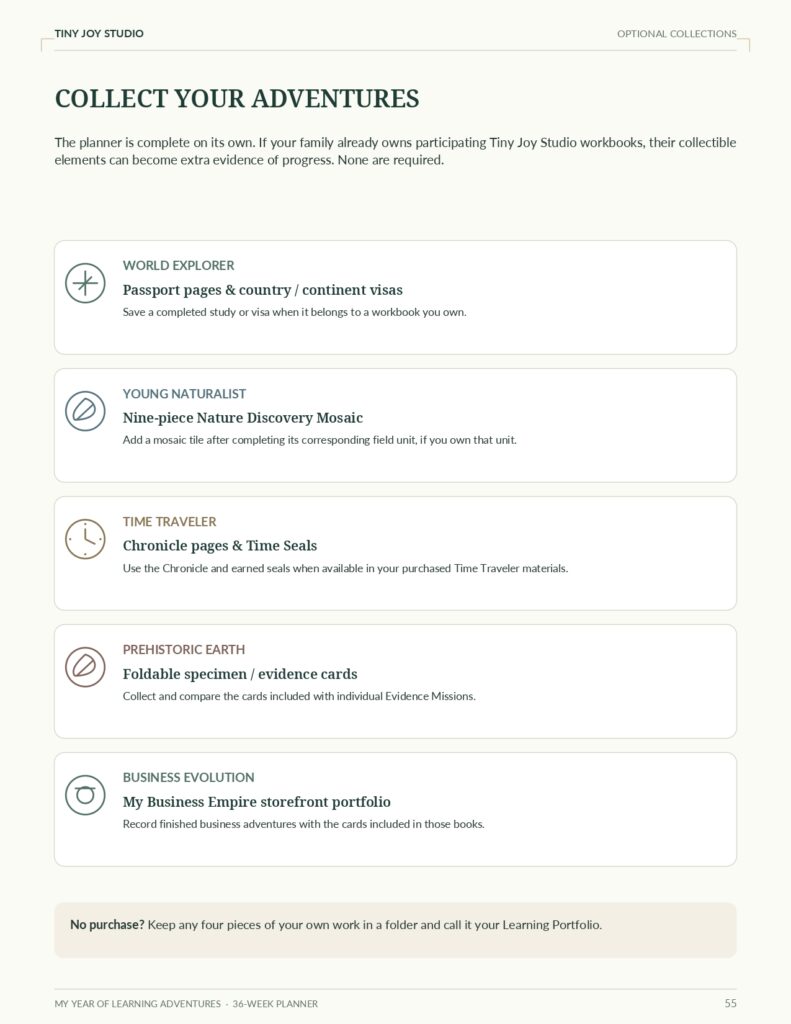
- Add Deeper Workbooks Only Where Curiosity Sparks: Let the free 36-week planner serve as your calm weekly spine, and pull in full 28- to 38-page Tiny Joy Studio workbooks—complete with collectible mosaic tiles, foldable specimen cards, and business empire storefronts—whenever your child wants to linger on a favorite world.
If you are ready to replace passive screen time with calm, curiosity-driven screen-free homeschool activities that build real map literacy, scientific observation, historical reasoning, and everyday decision skills, download your free 58-page planner above and start Week 1 whenever your family is ready.