Prehistoric Earth Workbooks for Kids: Investigate Dinosaurs, Ancient Oceans, and Lost Worlds
Popular dinosaur books and activity packs routinely mash tens of millions of years of prehistoric life into a single timeless jungle—where Tyrannosaurus rex battles Stegosaurus while pterosaurs swoop overhead and woolly mammoths graze in the background. Designed to replace that “prehistoric soup” with genuine scientific reasoning, prehistoric earth workbooks for kids invite young learners ages 7 to 10 to step into the shoes of field investigators and museum detectives. Instead of passive coloring sheets or memorized monster superlatives, our prehistoric earth workbooks for kids organize deep geological time into distinct, verified fossil worlds—training children to examine physical clues, test competing explanations, and build a complete, verifiable project in every volume.
Whether your child is auditing exaggerated sea-monster claims in a Jurassic ocean, tracking a sauropod across ancient mudflats, or mapping how an Ice Age mammoth survived a sudden shift in climate, every book in the Prehistoric Earth: Evidence Missions collection transforms curiosity into structured inquiry.

One Scientific Method Across Every Lost World
Every volume in Prehistoric Earth is a standalone 24- to 34-page printable investigation (plus answer keys and bonus cards) built around a shared scientific discipline. Rather than treating every museum illustration as settled fact, learners filter clues through three strict levels of scientific certainty:
- Direct Evidence (“The fossil shows…”): What is physically preserved and measurable in rock—such as ridged grinding molars, articulated thumb bones, or air-breathing skull openings.
- Supported Inference (“This suggests…”): Logical conclusions grounded in anatomy, sediment, and comparison—such as how a jaw structure worked or how an organism moved through water.
- Genuine Unknowns (“We do not know yet”): Details the fossil record cannot confirm—such as exact skin coloration, unrecorded hunting group sizes, or missing soft tissues.
Across each workbook, children move through a repeatable five-stage arc: receive an unfinished mission → learn to spot diagnostic traits → cross-check clues to rule out weak ideas → test their hypothesis against new evidence → complete and verify a final visual project.
Inside the Six-Book Prehistoric Earth Collection
Although every book is completely self-contained and can be explored in any order, the six missions work together as a cohesive progression across deep time—moving from foundational fossil tools to specialized ecosystems and planetary change:
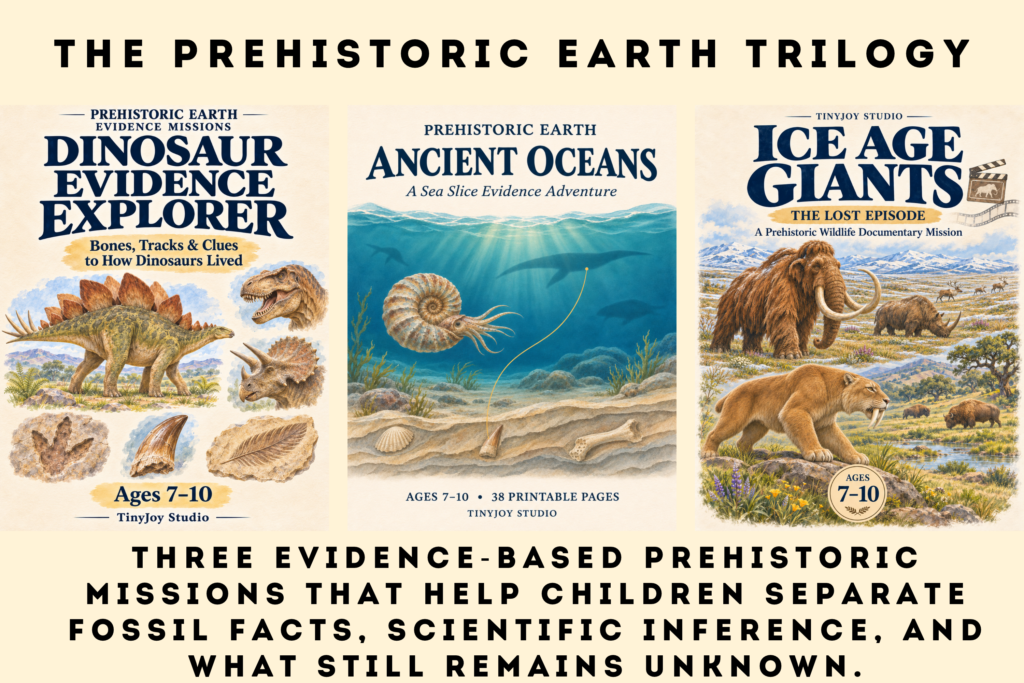
1. Dinosaur Evidence Explorer (Available Now)
- Core Question: How can we reconstruct an ancient animal from what survived—and how confident can our conclusions be?
- Inside the Mission: In our flagship dinosaur workbook for kids, learners separate Late Jurassic (Stegosaurus) and Late Cretaceous (T. rex) worlds by 83 million years, distinguish true terrestrial dinosaurs from flying pterosaurs and marine reptiles, read sauropod trackways, and solve real museum mysteries—including Oviraptor’s brooding nest and the 1878 Belgian discovery that moved Iguanodon’s spike from its nose to its thumb.

2. Before the Dinosaurs (In Production)
- Core Question: Who lived on land before the first dinosaurs, and how do we tell evolutionary kinship from surface look-alikes?
- Inside the Mission: Focusing on an Early Permian terrestrial ecosystem in North America, children untangle mixed-up specimen labels and discover why sail-backed animals like Dimetrodon and Edaphosaurus were synapsids—early relatives on the mammal lineage—rather than dinosaurs or giant lizards.
3. Pterosaurs and Prehistoric Skies (In Production)
- Core Question: What does a pterosaur’s anatomy reveal about how it launched, flew, and fed?
- Inside the Mission: Comparing wing membranes supported by an elongated fourth finger against birds, bats, and insects, learners rebuild an incomplete atlas page for a chosen pterosaur—evaluating skull crests, tooth shapes, wingspan scales, and ground movement while separating verified anatomy from artistic color choices.
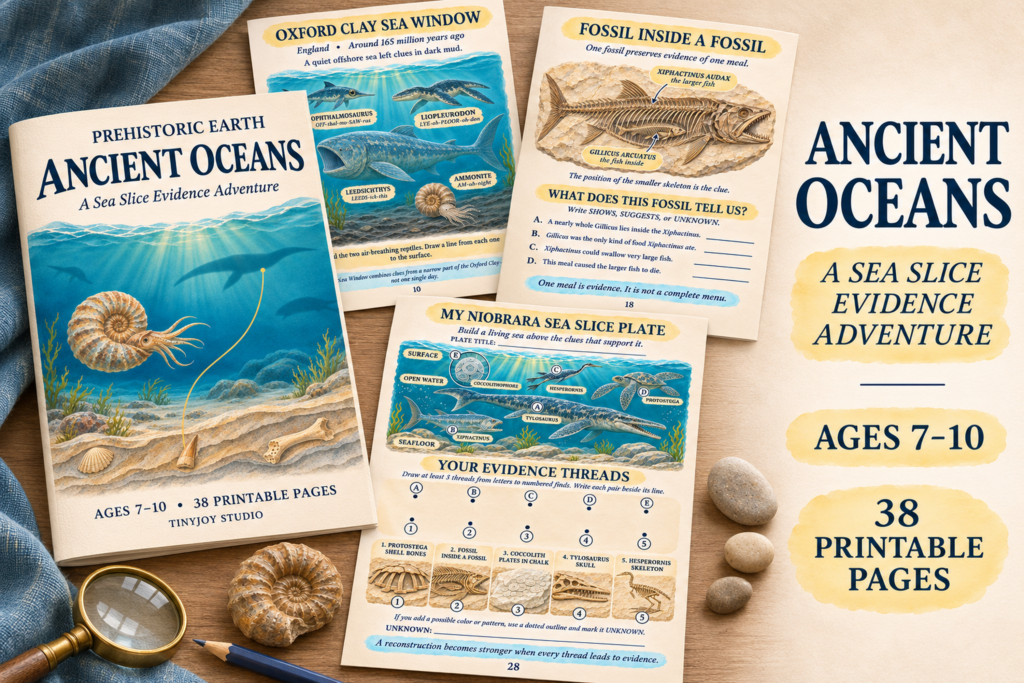
4. Ancient Oceans (Available Now)
- Core Question: How do fossils and seafloor rock layers reveal life inside vanished Mesozoic seas?
- Inside the Mission: Our ancient oceans workbook for kids takes investigators into two distinct marine windows: Middle Jurassic England (Oxford Clay) and Late Cretaceous Kansas (Niobrara Chalk). Students separate air-breathing marine reptiles (Ophthalmosaurus, Liopleurodon, Tylosaurus) from gill-breathing giant fish (Leedsichthys, Xiphactinus), audit exaggerated television monster sizes, and tether living ocean creatures to numbered fossils in the chalk layers below.
5. Ice Age Giants: The Lost Episode (Available Now)
- Core Question: What did massive Pleistocene animals need to survive, and how did shifting habitats reshape their world?
- Inside the Mission: Stepping into the Science Director’s chair in our ice age workbook for kids, learners contrast the cold, grassy Mammoth Steppe of Eurasia with the woodland asphalt traps of Rancho La Brea in Ice Age Los Angeles. They audit sensational documentary captions, compare extinct megafauna against living Arctic survivors like reindeer, and assemble a verified six-frame documentary cut.

6. Prehistoric Survivors & Changing Worlds (In Production)
- Core Question: Why does a sudden global shift create different challenges for different organisms, and how do we trace which lineages continued?
- Inside the Mission: Examining the Cretaceous–Paleogene boundary roughly 66 million years ago, learners test “before-and-after” resource models, revise predictions when new fossil clues arrive, and investigate why non-avian dinosaurs vanished while specific lineages—including early birds, crocodilian relatives, and champsosaurs—persisted.
The Collectible Bonus: 8 Foldable Evidence Cards in Every Volume
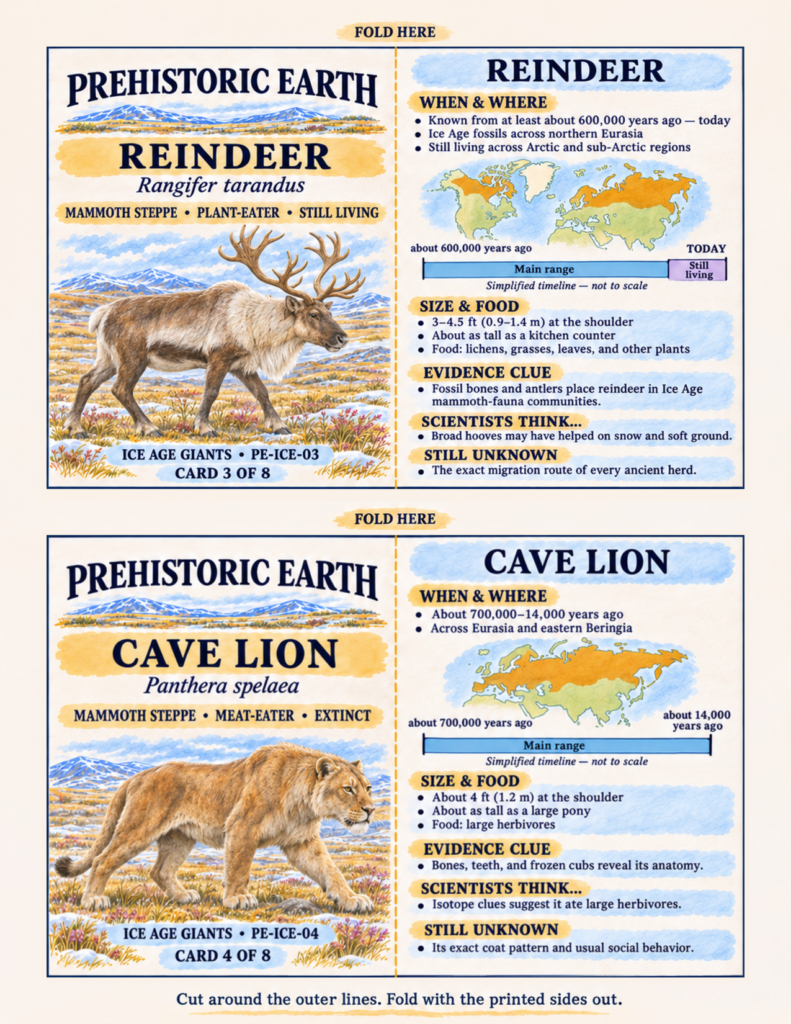
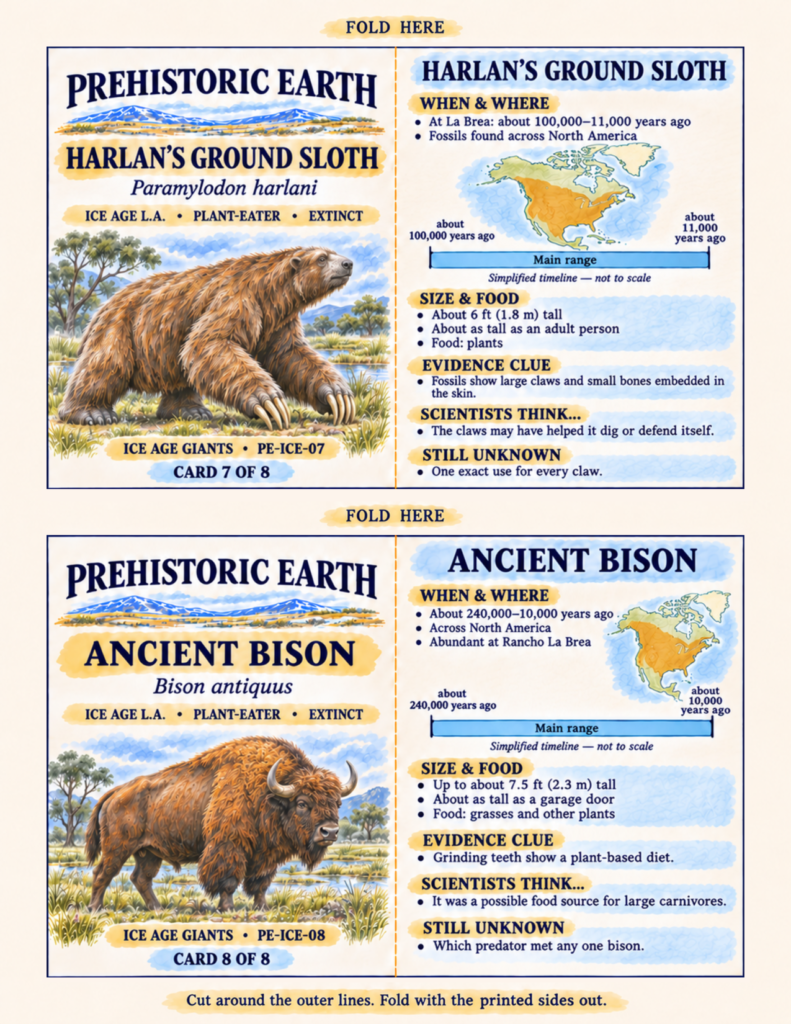
Every book in the Prehistoric Earth collection includes a separate bonus set of eight large, double-sided folding specimen cards (3.5 × 4.5 inches folded, printed two per US Letter sheet)—building up to a 48-card reference deck across the full six-book series:
- Front: Full-color, anatomically grounded watercolor artwork with the organism’s name and geological time window.
- Back: Structured field data covering When it lived, Fossils Found (specific formations rather than vague continents), Size (with explicit length, height, or wingspan units), Food, and a Look For diagnostic clue.
- Zero Gatekeeping: Each book is 100% self-contained—there are no mandatory “series passports” or locked final pages requiring you to buy every volume before finishing a mission.
Recommended Learning Pathway & Where Younger Explorers Can Start
While families can jump into any title in any sequence, the series offers a natural learning route that builds analytical tools step by step:
| Recommended Sequence | Book Title | Status | Primary Scientific Skill |
| 1. Foundations | Dinosaur Evidence Explorer | Available Now | Separating direct fossil evidence, inference, and unknowns |
| 2. Deep Time & Kinship | Before the Dinosaurs | Coming Soon | Reading branching family trees and pre-dinosaur Permian life |
| 3. Functional Anatomy | Pterosaurs and Prehistoric Skies | Coming Soon | Connecting wing, crest, and tooth structure to flight and diet |
| 4. Marine Ecosystems | Ancient Oceans | Available Now | Stratigraphic sea slices, air vs. gill breathing, and food chains |
| 5. Habitat & Adaptation | Ice Age Giants: The Lost Episode | Available Now | Matching animal needs to changing Pleistocene environments |
| 6. Synthesis & Change | Prehistoric Survivors & Changing Worlds | Coming Soon | Testing ecosystem disruption models against fossil survival records |
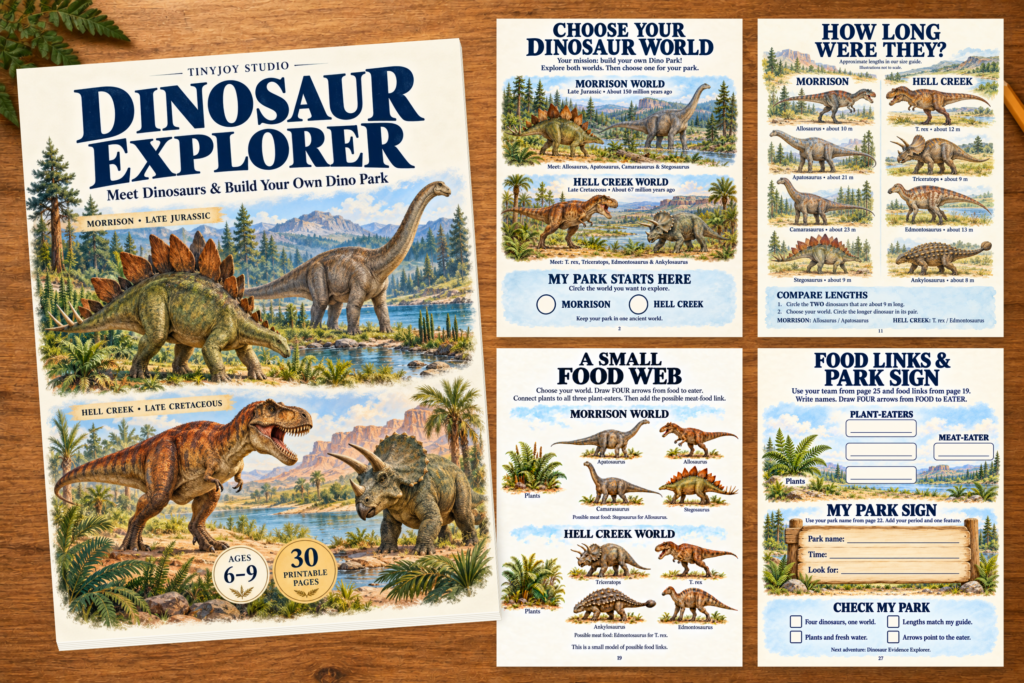
- Have a Younger Learner (Ages 6–9)? Before diving into the 7–10 evidence missions above, younger dinosaur fans can start with our standalone introductory park-building adventure, Dinosaur Explorer: Build Your Own Dino Park, which introduces Late Jurassic vs. Late Cretaceous separation, 1-square-equals-1-meter grid scaling, and basic food-web arrows.
Connecting Prehistoric Earth Across the Tiny Joy Studio Library
Prehistoric Earth anchors the deep-time wing of our broader Explore the Past history curriculum for kids, bridging natural history and human civilizations inside the Tiny Joy Studio Learning Library. To give your learners an even stronger grasp of how rocks preserve ancient clues, pair these missions with our hands-on Fossils Workbook for Kids and Rocks and the Rock Cycle Workbook inside our Discover Nature science curriculum for kids.
Whether your child starts with Jurassic oceans, Cretaceous trackways, or Ice Age megafauna, prehistoric earth workbooks for kids turn a childhood fascination with ancient creatures into lifelong scientific literacy.
Start with Any Adventure. Three Prehistoric Earth Evidence Missions are available now, with three more planned for the growing collection. Each workbook offers a complete, independent investigation, so young explorers can begin with dinosaurs, ancient oceans, or Ice Age giants — whichever subject interests them most.
Explore the Prehistoric Earth Collection on Etsy