Discover Nature: A Field-Based Life Science, Earth Systems & Young Naturalist Curriculum for Kids
Children are born naturalists—eager to crouch beside a line of ants, pocket a sparkling pebble, or ask why leaves turn yellow on one branch before another. Yet most elementary nature printables turn that curiosity into passive busywork: color a cartoon frog, circle five bugs on a checklist, and move on. Designed to cultivate genuine scientific observation from ages 5 to 12, the discover nature science curriculum for kids from Tiny Joy Studio unites structured outdoor fieldwork with deep-dive investigations into living systems, biomes, and Earth’s rocky history.
As the fourth core pillar of the Tiny Joy Studio Learning Library, Discover Nature brings together two complementary branches: our Young Naturalist outdoor field series (a foundational field journal plus nine 4-week thematic units) and our Earth & People life science, biome, and geology collections. Whether your learner is stepping outside with a magnifying glass or analyzing controlled plant and rock experiments at the kitchen table, every volume trains the same habit: observe carefully, separate direct evidence from guesses, and respect living habitats.
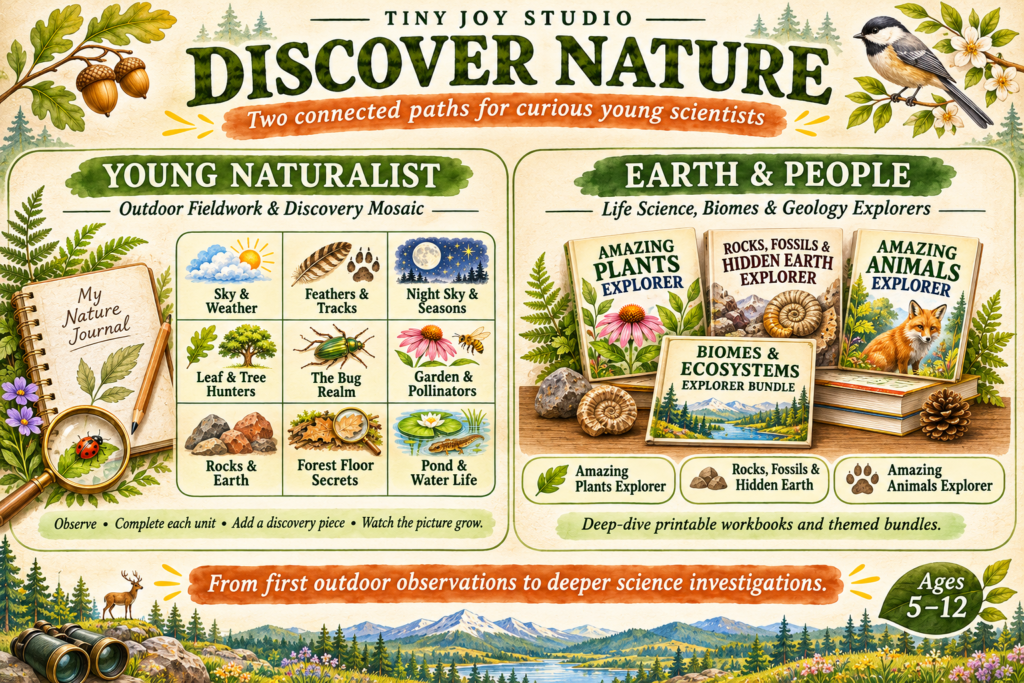
Pillar 1: The Young Naturalist Series — Outdoor Fieldwork & 9 Four-Week Units
Outdoor study works best when children know how to look without disturbing delicate habitats. Our Young Naturalist branch guides learners from gentle sensory awareness into disciplined, month-long scientific fieldwork:
Step 1: The Foundational Entry Journal (Ages 5–9)
Children begin their outdoor routine with My First Nature Journal—a standalone, sensory-rich nature journal for kids built around the repeatable “Choose, Observe, Wonder” cycle and the ethical “Look, Don’t Take” stewardship code. Through 5-minute sound maps, bark and leaf texture rubbings, color hunts, and organism clue frames, young explorers build calm observational habits before tackling specialized science units.

Step 2: Nine 4-Week Specialized Field Units (Ages 7–12)
When learners are ready for deeper investigation, Young Naturalist expands into nine self-paced, 32-page four-week field units. Every unit runs on a predictable weekly pulse—Learn → Think → Go → Observe → Make → Check—and includes detailed Home Field Scenes so families can complete every clue audit even during winter storms or apartment-based study:
- The Bug Realm (Insects & Microhabitats): Explore anatomical body clues, camouflage, complete vs. incomplete metamorphosis, and ecological insect jobs in our insects field unit for kids.
- Leaf & Tree Hunters (Botany & Seasonal Change): Decode crown silhouettes, simple vs. compound leaf margins, and winter twig buds in our tree identification for kids unit.
- Forest Floor Secrets (Decomposition & Soil Webs): Inspect surface litter layers without digging, separate fungus, moss, and lichen, and meet nature’s recycling crew in our forest floor science for kids guide.
- Feathers & Tracks (Wildlife Signs & Deduction): Measure print scale, read repeating trackways, and distinguish direct evidence from guesses in our animal tracks and bird signs for kids unit.
- Sky & Weather Watchers (Clouds, Wind & Moisture): Track cloud layers, ground vs. upper-level wind clues, and overnight dew in our weather workbook for kids.
- Rocks & Earth Detectives (Local Stones, Soil & Erosion): Describe rock traits before naming, trace soil profiles, and track Break–Move–Rest weathering trails in our rocks and soil workbook for kids.
- Expanding Across All Nine Slots: The complete nine-unit circle also includes Garden & Pollinators, Pond & Water Life, and Night Sky & Seasons.

The Collectible 9-Piece Nature Discovery Mosaic
To give long-term outdoor study tangible momentum, completing each of the nine 4-week units unlocks a full-color $3 \times 2$-inch discovery tile. Learners cut and paste each earned piece onto the master My Nature Discovery Mosaic poster—assembling a nine-part woodland and sky panorama one four-week expedition at a time.

Pillar 2: Earth & People Science — Living Systems, Biomes & Earth Materials
While Young Naturalist anchors learning in local outdoor observation, our Earth & People science workbooks (ages 7–10) zoom out to investigate global ecosystems, botanical and animal life cycles, sensory biology, and geological processes through controlled data tables, cross-section diagrams, and model-repair labs:
Global Biomes & Interconnected Ecosystems
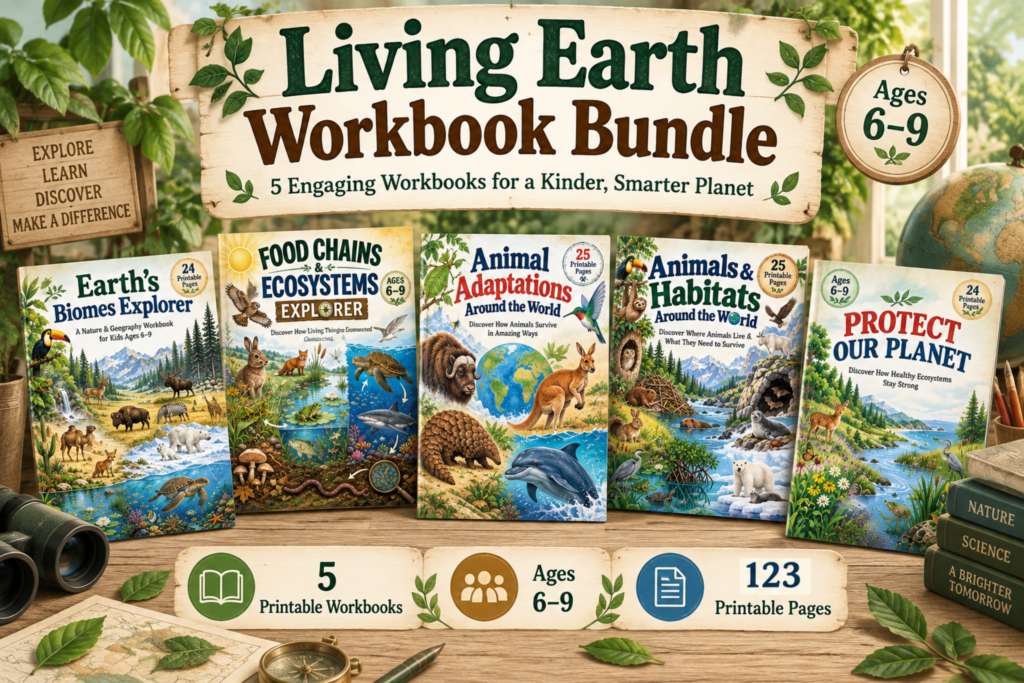
- Biomes and Ecosystems Workbook Bundle for Kids: Uniting 150 printable pages across five complete field guides (Tropical Rainforest, Coral Reef & Ocean Life, Savanna & Grassland, Wetlands, and Arctic & Tundra), this collection teaches children to analyze every habitat through five scientific lenses—Structure, Resource, Flow, Connection, and Change.
- Nature Workbooks for Kids: Explore our full catalog of modular 28- to 30-page life science investigations spanning diverse terrestrial and aquatic habitats.

Plants, Pollinators & Animal Life Science
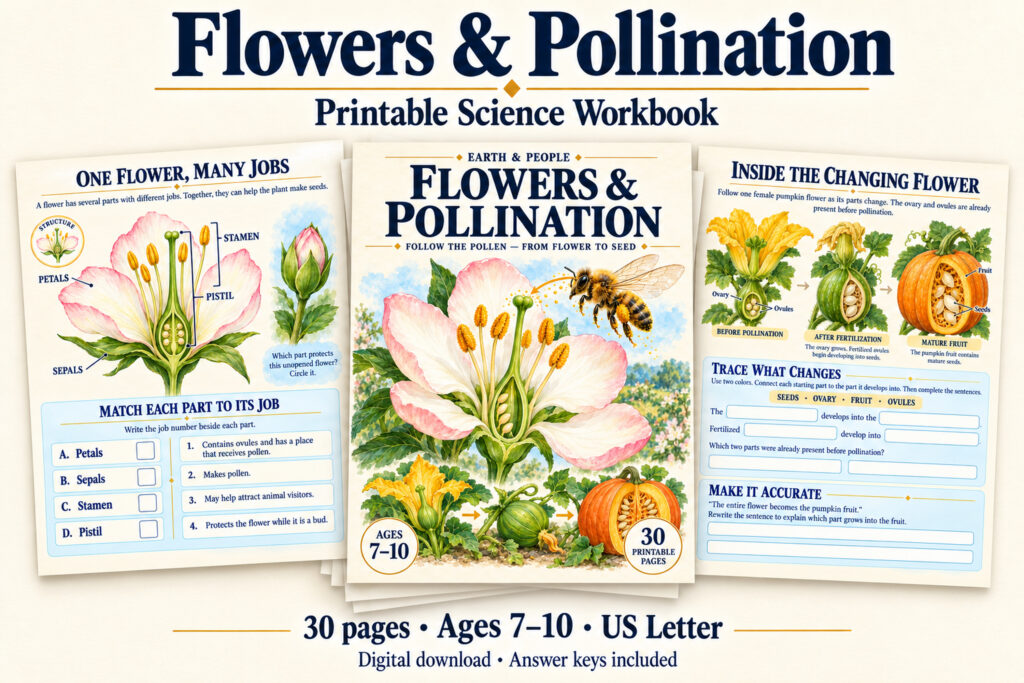
- Botany & Pollination: Debunk the “plants eat dirt” myth with dry-mass scale data and test germination variables in our Plant Life Cycle Workbook, then trace floral rewards, pollen transfer, and fruit development in our Pollination Workbook for Kids.
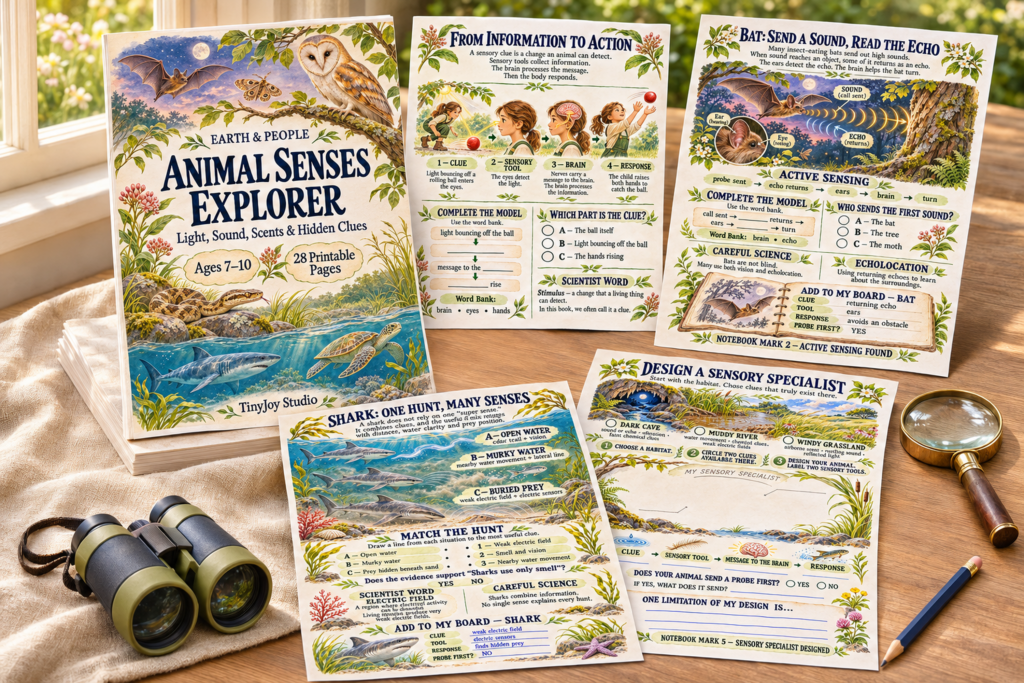
- Animal Life Cycles, Insects & Sensory Biology: Compare complete and incomplete metamorphosis and vertebrate development in our Animal Life Cycles Workbook, investigate insect anatomy and ecological roles in our Insects Workbook for Kids, and test how animals detect invisible magnetic, acoustic, and chemical clues in our Animal Senses Workbook for Kids.
Rocks, Minerals, Fossils & Planetary Systems
- Earth’s Crust, Crystals & Fossil Records: Trace how igneous, sedimentary, and metamorphic rocks transform through heat, pressure, and erosion in our Rocks and the Rock Cycle Workbook; escape the “color trap” using streak, hardness, and crystal-lattice tests in our Minerals and Crystals Workbook for Kids; and decode ancient environments from body and trace fossils in our Fossils Workbook for Kids.
- Dynamic Earth & Space Connections: Pair surface geology with tectonic plate mechanics in our Dynamic Earth Workbook Bundle, or extend seasonal weather and night-sky observations into planetary astronomy with our Earth and Space Science Bundle for Kids.


How to Combine Young Naturalist & Earth & People at Home
| Learner Profile & Goal | Recommended Pathway | Ideal Ages | Key Scientific Habits Built |
| Gentle Outdoor Starter | My First Nature Journal + seasonal backyard walks | Ages 5–9 | Multi-sensory observation, sketching, wonder questions, and stewardship |
| Year-Round Outdoor Field Science | Young Naturalist 4-Week Field Units + Mosaic Poster | Ages 7–12 | Repeatable weekly inquiry, honest zero-result logging, and field classification |
| Indoor Biology & Ecology Deep Dives | Biomes & Ecosystems Bundle + Plants, Pollination & Animals | Ages 7–10 | Five-lens systems thinking, controlled variable testing, and food-web modeling |
| Rocks, Crystals & Deep-Time Earth Science | Rocks & Earth Unit + Rock Cycle, Minerals & Fossils | Ages 7–10 | Multi-variable property testing, stratigraphic clues, and Earth cycle modeling |
Connecting Nature Science to Geography, History & Real-World Systems
Understanding how living organisms and Earth materials work gives children a powerful foundation for every other subject in the Tiny Joy Studio ecosystem:
- Connect Ecosystems to World Terrain & Cultures: Pair biome and watershed investigations with our Explore Our World geography curriculum for kids to see how mountain ranges, rivers, and climate bands shape human communities across six continents.
- Step from Fossils into Deep Geological Time: Take the investigative habits from Fossils and Rocks & Earth straight into our Explore the Past history curriculum for kids, where Prehistoric Earth separates Jurassic oceans, Cretaceous dinosaurs, and Ice Age megafauna through verified fossil windows.
- Apply Resource & Systems Logic to Everyday Decisions: Once learners see how ecosystems balance scarce energy, water, and nutrients, challenge them with our Build, Decide & Grow kids business curriculum to manage capacity, supply chains, and trade-offs across 10 playable businesses.
Whether your child is sketching cloud shapes on the back porch, testing mineral streak plates at the kitchen table, or unlocking all nine tiles of the Nature Discovery Mosaic, the discover nature science curriculum for kids turns everyday curiosity into lasting scientific confidence.