Project-Based Learning for Kids: How to Turn Everyday Curiosity Into Real-World Skills
Mention project-based learning for kids in an elementary classroom or homeschool group, and most adults immediately picture a shoebox diorama, a baking-soda volcano, or a tri-fold poster covered in glued-on clip art. While crafts can be fun, decorative builds often spend 90% of a child’s energy on scissors and markers while leaving actual reasoning untouched. Genuine project-based learning for kids works in the opposite direction: it begins with a real constraint, asks learners to test evidence and trade-offs, and culminates in a verifiable artifact that proves how a system works.
Across every series in the Tiny Joy Studio Learning Library, workbooks are engineered so children do not finish with a graded bubble test—they finish as park designers, museum curators, transport planners, field naturalists, and shop managers who can defend their decisions with concrete evidence.
What Separates Real Projects From Decorative Busywork
When children build something meaningful—whether a regional transit map, a seasonal shadow log, or a five-day bookstore budget—the project succeeds because it follows a five-step thinking cycle:
- An Unfinished Brief With Real Constraints: Every strong project gives clear limits—such as an 8-token transport budget, a single geological period, or an $8 protected cash floor—so children cannot simply wish away hard choices.
- Evidence Before Opinion: Learners gather observable clues first, separating what a map, fossil, or timetable directly shows from what is inferred or unknown.
- Auditing a Broken Model: Before building from scratch, students diagnose and repair a flawed example—spotting mixed-up eras, missed train transfers, or an overdrawn Tuesday rent bill.
- Constructing a Verifiable Artifact: Children create a map, exhibition label, food web, or financial ledger that can be checked against clear, objective rules.
- Defending the Result (Claim – Evidence – Reasoning): Rather than saying “my plan is better,” learners cite a specific measurement, date, or dollar figure to explain why their design holds up.
Four Real-World Project Examples Across Subjects (Ages 6–12)
To see how thinking-first projects translate across disciplines without screens or expensive kits, look at how four core branches in our library turn abstract topics into concrete builds:
1. Geography & Infrastructure: Designing Transit and School Networks
Instead of memorizing lists of landforms, learners inside our Explore Our World geography curriculum for kids solve applied spatial engineering briefs:
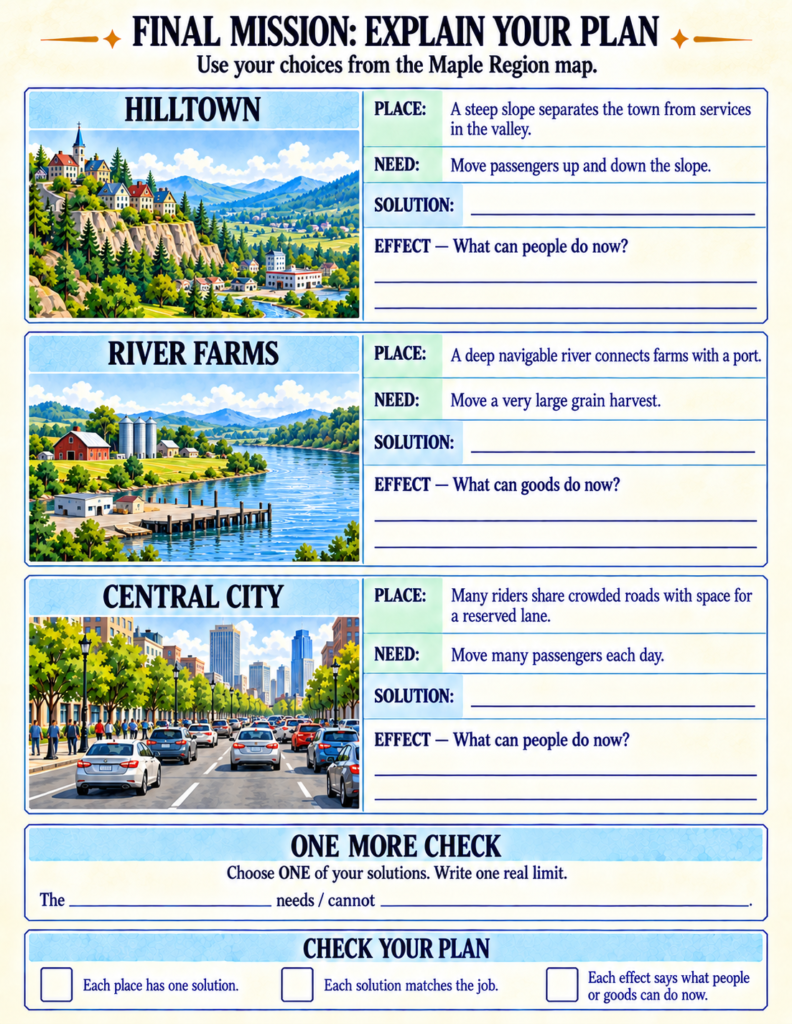
- Regional Transit Engineering: In Transport Around the World (Page 23, “Engineering the Maple Region”), students match cog railways, express buses, and cargo barges to steep mountain passes and river corridors across three settlements.
- Climate-Adapted Community Planning: In School Around the World (Page 26, “The Learning Bay Brief”), learners map a coastal school network that accounts for monsoon flood zones, midday heat schedules, multigrade classroom helpers, and boat delivery lines.
2. Deep Time & Paleontology: Habitat Scaling & Museum Curation
Inside our Explore the Past history curriculum for kids and Prehistoric Earth workbooks for kids, projects train young researchers to respect time boundaries and physical evidence:
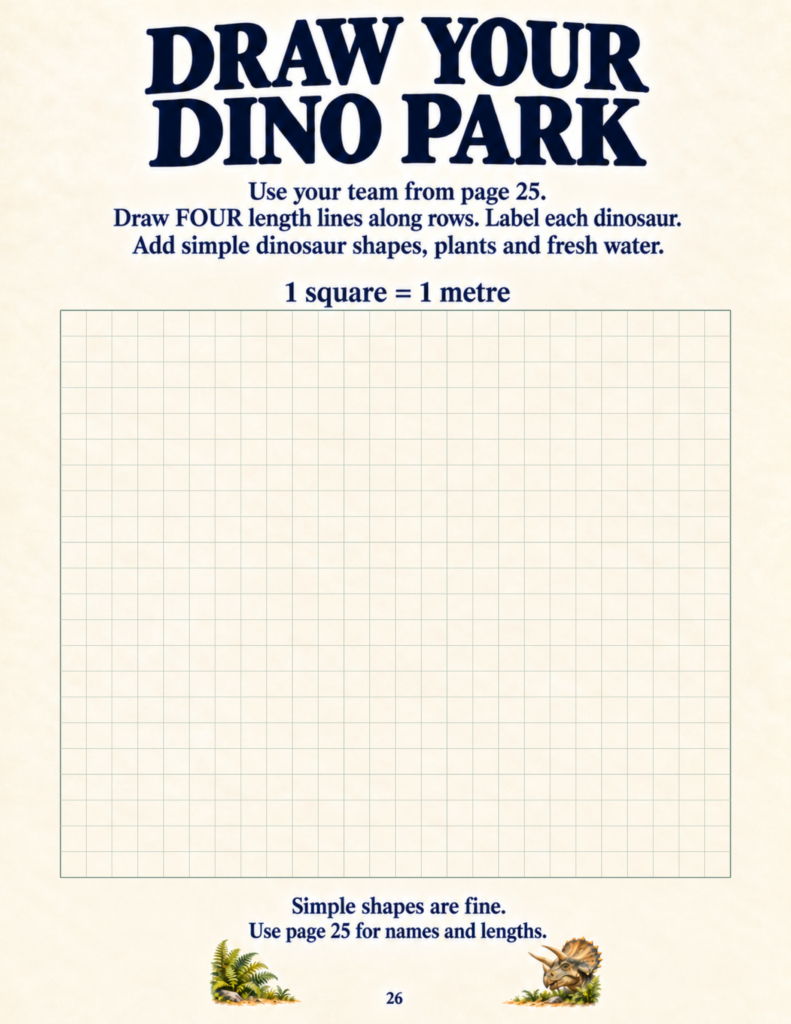
- Scale Habitat Mapping: In Dinosaur Explorer (Pages 25–27), younger investigators (ages 6–9) choose either Late Jurassic Morrison or Late Cretaceous Hell Creek, plot four era-matched dinosaurs onto a $1\text{ square} = 1\text{ meter}$ grid, connect food-web arrows from food to eater, and write a factual park sign.
- Evidence-Verified Documentary & Museum Exhibits: In Ice Age Giants and Dinosaur Evidence Explorer (ages 7–10), older learners audit sensational claims, assemble verified documentary sequences, and build a deck of 48 foldable specimen cards.
3. Living Systems & Earth Science: Field Guides & Forensic Identification
Within our Discover Nature science curriculum for kids, projects turn backyard walks and tabletop labs into authentic scientific documentation:
- Forensic Specimen Audits: In Minerals and Crystals (Page 24, “The Mixed-Up Mineral Delivery”), learners cross-check hardness, streak color, and cleavage tags to re-label crates of mystery specimens.
- Longitudinal Field Portfolios: Across Young Naturalist 4-week units—such as The Bug Realm, Leaf & Tree Hunters, and Feathers & Tracks—students build pocket twig clue cards, fringed paper feather models, and unlock tiles for the nine-piece My Nature Discovery Mosaic poster.
4. Microeconomics & Decision-Making: Multi-Day Cash & Pricing Ledgers
Inside our Build, Decide & Grow kids business curriculum, every workbook is a playable decision simulation:
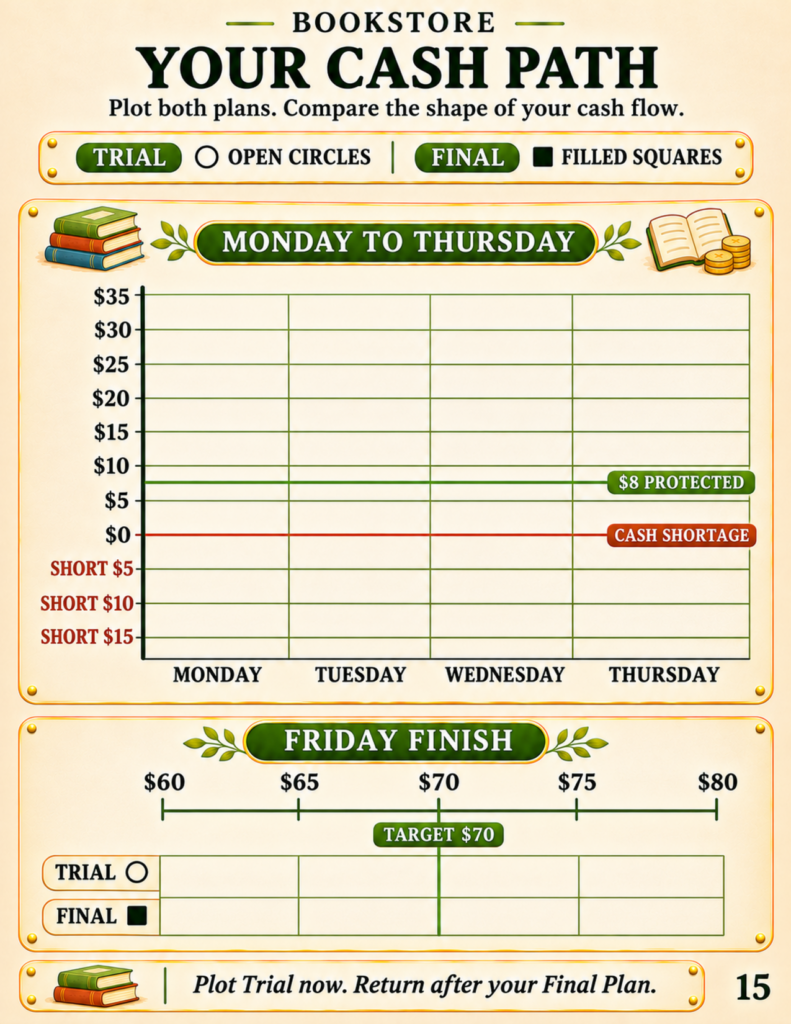
- Five-Day Cash Flow Modeling: In Bookstore: The Cash Flow Challenge (our cash flow workbook for kids, Page 15), students test optional projects across a Monday–Friday ledger, plot two cash paths on a coordinate grid, and prove how a shop can earn $28 profit while keeping closing cash safely above an $8 protected reserve every single day.
- Price-Testing & Empire Building: Completing Bookstore, Weekend Wheels (business workbook for kids), or Supermarket (pricing and demand workbook for kids) unlocks cut-out storefront cards for the 10-business My Business Empire portfolio.
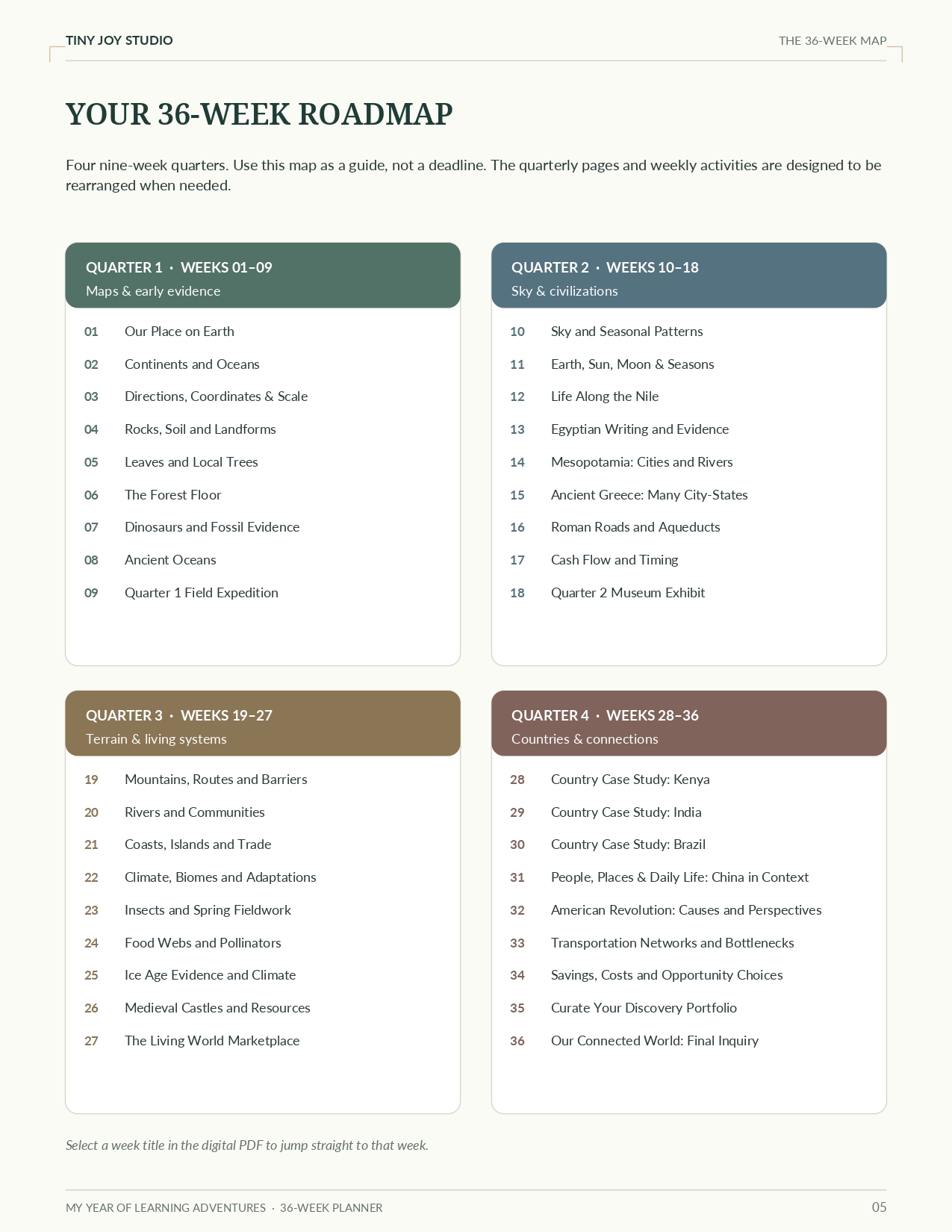
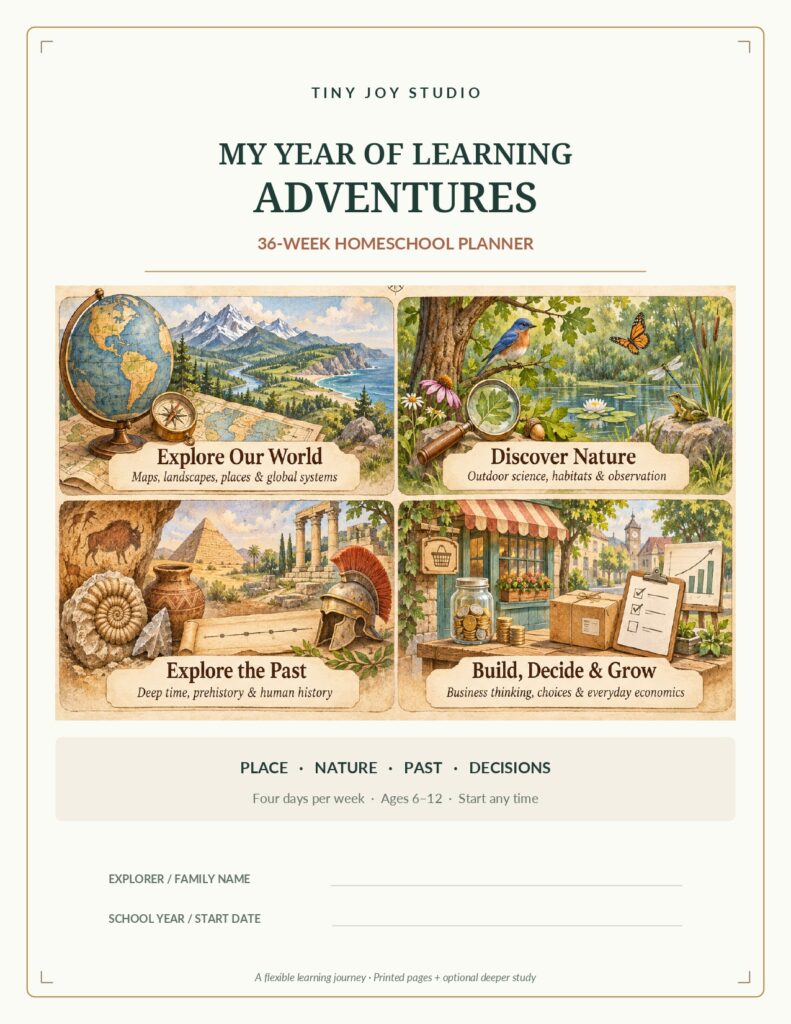
Free Download: My Year of Learning Adventures — 36-Week Homeschool Planner (58-Page Printable PDF)
Want a ready-made weekly rhythm that builds small, manageable projects into your homeschool routine without requiring extra purchases? Download our complete 58-page printable project and curriculum planner for ages 6 to 12:
- 36 Optional Friday Mini-Projects: Alongside four short 20–30 minute Monday–Thursday prompts (Place, Nature, Past, and Decisions), every week includes a concrete Friday build—such as folding a mini-atlas, testing water flow down a tilted foil aqueduct channel, constructing a paper relief mountain pass, or running a seven-day bookstore coin ledger.
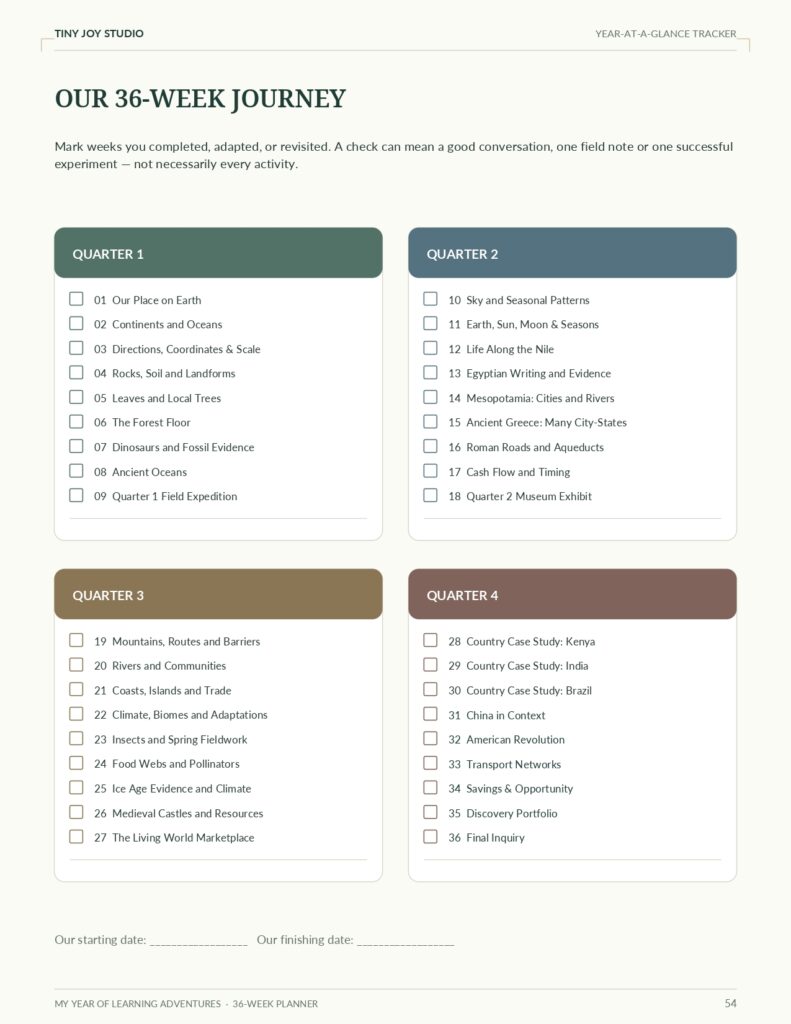
- Four Quarterly Capstone Checkpoints: Every nine weeks culminates in a synthesis project—Quarter 1 Field Expedition (Week 9), Quarter 2 Museum Exhibit (Week 18), Quarter 3 Living World Marketplace (Week 27), and Quarter 4 Discovery Portfolio & Connected World Exhibit (Weeks 35–36).
- Two Built-In Challenge Tiers (Ages 6–8 vs. Ages 9–12): Younger learners draw, sort, and explain orally, while older learners build comparison tables, audit sources, and defend multi-criteria trade-offs.
- Zero-Cost Materials + Optional Workbook Pairings: Every project works with ordinary paper, pencils, play coins, and our curated directory of free public museum archives (Page 51)—with clickable links and QR codes whenever you want to dive into a full Tiny Joy Studio workbook.
✦ FREE HOMESCHOOL RESOURCE ✦
Your 36-Week Homeschool Learning Planner
A free 58-page printable planner with 36 themed weeks, four connected learning paths, age-adapted activities, and weekly reflections for curious learners ages 6–12.
Free PDF · US Letter · No Purchase Required
Three Practical Habits for Running Projects at Home
Whether you use our free 36-week planner as your weekly spine—paired with our screen-free homeschool activities guide and year of learning adventures at home roadmap—or dive straight into standalone workbooks, three habits keep project-based learning joyful:
- Keep Projects Compact and Verifiable: A 30-minute scale map or a four-panel museum label completed independently beats a sprawling three-week craft that ends with a parent doing the cutting at midnight.
- Celebrate Revised Plans, Not Just First-Try Perfection: In our books, discovering a Tuesday cash shortage or a missed ferry transfer on a Trial Plan is part of the design—revising the model with evidence is where real learning happens.
- Curate a Four-Artifact Portfolio: Save your child’s favorite map, dated field observation, sourced historical clue, and revised budget decision in a single folder so they can see how their thinking matured over the year.
If you are ready to move past passive worksheets and decorative crafts, project-based learning for kids gives curious learners ages 6 to 12 the tools to map, test, build, and explain how their world works.