How to Build a Year of Learning Adventures at Home: A 36-Week Screen-Free Roadmap
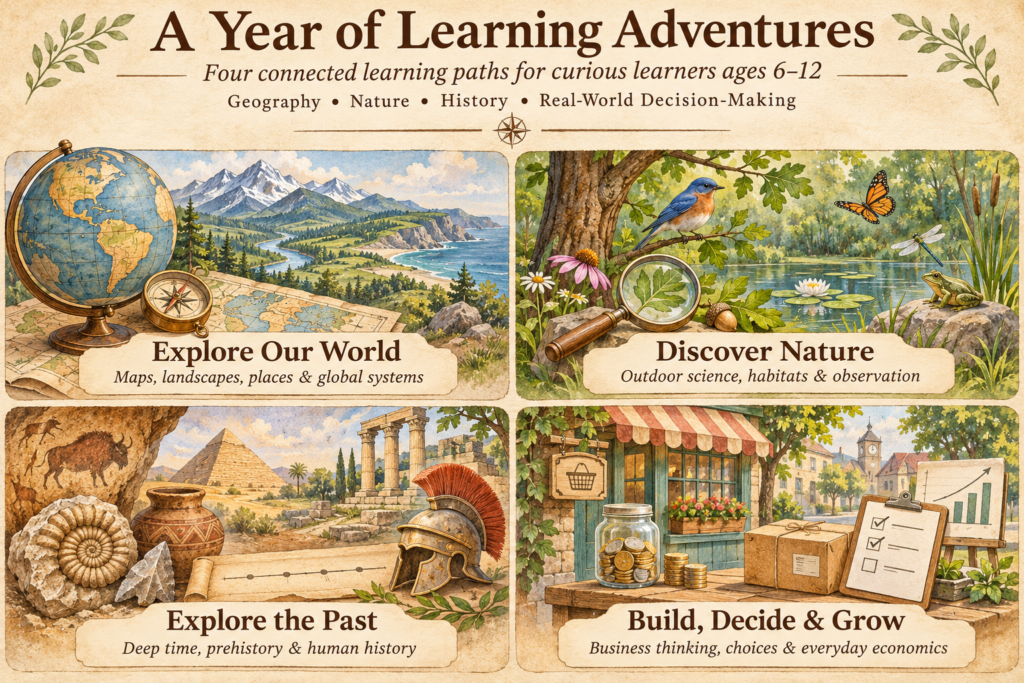
Planning a full homeschool year often pulls families toward two frustrating extremes: either buying a rigid, all-in-one textbook box that drains a child’s curiosity by October, or downloading disconnected worksheets that never build a coherent picture of how the world works. Designing a thoughtful year of learning adventures at home solves both problems at once. Instead of marching through isolated subjects in separate silos, a well-paced year of learning adventures at home weaves four essential lenses—place, nature, human history, and real-world decision-making—into a calm, 36-week rhythm for learners ages 6 to 12.
✦ FREE HOMESCHOOL RESOURCE ✦
Your 36-Week Homeschool Learning Planner
A free 58-page printable planner with 36 themed weeks, four connected learning paths, age-adapted activities, and weekly reflections for curious learners ages 6–12.
Free PDF · US Letter · No Purchase Required
Using the modular, print-and-go workbooks inside the Tiny Joy Studio Learning Library, you can assemble a complete four-quarter learning roadmap without bulky teacher manuals, screen-dependent apps, or hours of Sunday-night prep.
The Weekly Rhythm: Four Anchors, Zero Overwhelm
Before mapping out all 36 weeks, it helps to establish a sustainable weekly pulse. Rather than cramming every subject into every afternoon, many families thrive on a four-day core rhythm of 20 to 30 minutes per day, leaving Fridays open for outdoor field walks, library visits, hands-on craft models, or catching up:
| Day of the Week | Curriculum Pillar | Core Question Your Child Explores | Typical Session Format (20–30 Min) |
| Monday: Place | Explore Our World geography curriculum for kids | Where are we on Earth, and how does this terrain work? | Map literacy, coordinate grids, landform cross-sections, or country clues |
| Tuesday: Nature | Discover Nature science curriculum for kids | What lives here, and what physical clues does Earth leave? | Young Naturalist weekly module or Earth & People lab data |
| Wednesday: Past | Explore the Past history curriculum for kids | How did ancient creatures or human societies live here? | Prehistoric Earth clue audit, Time Traveler mission, or Focused History unit |
| Thursday: Decisions | Build, Decide & Grow kids business curriculum | How do people manage scarce time, money, and trade-offs? | Playable Business Evolution ledger, price test, or booking grid |
| Friday: Field & Make | Outdoor & Portfolio Day | What can we observe, build, or verify firsthand? | Backyard nature scan, foldable specimen cards, or mosaic/empire card updates |
Because every Tiny Joy Studio workbook is built around clear visual scaffolds and self-contained answer keys, children gradually take ownership of their own investigations while parents act as calm coaches rather than lecturers.
A Complete 36-Week Roadmap Across Four Seasons
Below is a balanced four-quarter (36-week) learning path that connects geography, natural science, deep time, history, and applied math so each quarter reinforces what came before:
Quarter 1 (Weeks 1–9): World Maps, Deep Time & First Trade-Offs
- Geography Spine: Start at Step 1 of our geography learning path for kids (World Explorer Series: Global Foundations) alongside the Explorer Skills Workbook Bundle so learners master continents, climate bands, compass bearings, and map scales before tackling individual countries.
- Nature & Earth Science: Launch outdoor observation with My First Nature Journal (nature journal for kids) for ages 5–9, or dive into two autumn 4-week field units (Leaf & Tree Hunters and Forest Floor Secrets) paired with rocks, soil, and fossil basics.
- Deep-Time History: Anchor chronological thinking at the beginning of Earth’s fossil record with our Prehistoric Earth workbooks for kids—starting with dinosaur workbook for kids (Dinosaur Evidence Explorer) and ancient oceans workbook for kids.
- Applied Economics: Introduce opportunity cost and limited daily capacity with Weekend Wheels in our flagship business workbook for kids.

Quarter 2 (Weeks 10–18): Ancient Civilizations, Space Mechanics & Cash Timing
- Nature & Space Science: As winter shortens daylight hours, connect seasonal sky observations (Sky & Weather Watchers and Feathers & Tracks) to planetary mechanics inside the Earth and Space Science Bundle for Kids.
- Human History & Civilizations: Step from prehistory into human societies with Mia’s 18-part interactive history for kids curriculum (Time Traveler), pausing for a multi-week civilization deep dive using our Focused History unit studies for kids—such as Ancient Egypt (Pyramids, Hieroglyphs & Temples) or Ancient Rome (Aqueducts, Roads & Colosseum).
- Applied Economics: Pair Roman engineering and ancient trade logistics with Bookstore in our cash flow workbook for kids—teaching learners why cash timing and protected reserves matter—alongside Print Studio (Quality Control & Rework).
Quarter 3 (Weeks 19–27): Global Biomes, Regional Terrain & Market Demand
- Geography Spine: Advance to Step 2 of the World Explorer Series (Regional Systems & Physical Corridors) paired with the World Landscapes Workbook Bundle for Kids to see how mountain chains, river basins, and coastlines govern climate and settlement.
- Living Systems & Spring Fieldwork: Connect regional climates to global habitats with the Biomes and Ecosystems Workbook Bundle for Kids, while stepping outside for spring Young Naturalist units (The Bug Realm and Garden & Pollinators).
- Prehistory & Era Bridges: Contrast warm Mesozoic seas with Pleistocene climates in our ice age workbook for kids (Ice Age Giants: The Lost Episode) alongside medieval Focused History studies (Knights and Castles).
- Applied Economics: Test how buyer demand responds to price and weather clues with Supermarket in our pricing and demand workbook for kids and Ice Cream Truck (Forecasting & Inventory).
Quarter 4 (Weeks 28–36): Individual Countries, Turning Points & Scaling Systems
- Geography Spine: Reach Step 3 of the World Explorer Series (Individual Country Deep Dives) alongside the People and Places Workbook Bundle—exploring national capitals, symbols, transportation networks, and daily cultural life across six continents.
- Nature Capstone: Complete Pond & Water Life and Night Sky & Seasons to place the final tiles onto the nine-piece My Nature Discovery Mosaic poster.
- Historical Turning Points: Investigate cause, escalation, and primary perspectives with Road to Revolution (American Revolution Unit Study) inside Focused History.
- Applied Economics Capstone: Tackle multi-step systems—Delivery Company (Logistics), Pizza Empire (Scaling), or Apex Network (Supply Chains)—and add the final storefront cards to the 10-business My Business Empire portfolio.
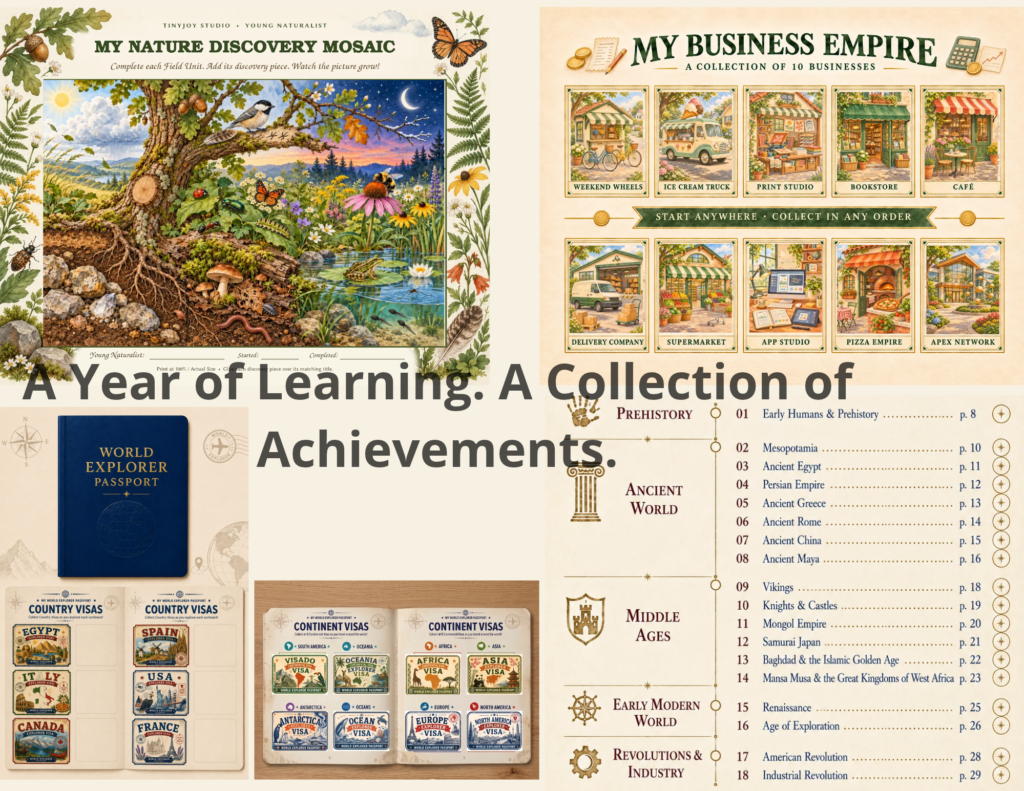
Learning That Leaves Something Behind. Across Tiny Joy Studio’s interconnected collections, children build a tangible record of their discoveries. They complete the Young Naturalist Discovery Mosaic, collect World Explorer Passport visas, document historical adventures in the Time Traveler Chronicle, assemble prehistoric specimen cards, and grow their My Business Empire portfolio. Each milestone represents another completed investigation, new skills practiced, and knowledge gained throughout the year.
Ready to Plan Your Learning Year?
Get your free 36-week printable planner and start exploring at your own pace.
Two Alternative Ways to Customize Your Year
Not every family follows a traditional four-quarter school calendar. Depending on your learners’ ages and attention spans, you can remix the exact same library into two other proven formats:
- Four-Week Cross-Curricular Deep Dives (Unit-Study Clusters): Spend a full month immersed in one interconnected theme—for example, pairing Ancient Rome (Time Traveler + Focused History Aqueducts & Colosseum) with Mediterranean geography and Delivery Company logistics.
- One Table, Multiple Ages (Ages 6–7 + Ages 9–11): Keep siblings studying the same broad topic at matched depth. Younger learners can explore My First Nature Journal and Dinosaur Explorer, while older siblings run 4-week Young Naturalist clue audits, Prehistoric Earth evidence missions, and multi-day Business Evolution ledgers.
Whenever you are ready to map out a year of learning adventures at home, start with just one workbook from each of the four pillars above—and let your child’s curiosity set the pace from week to week.